NAVALNY Alexei
04 Jun 1976 GREG CAL
friday GREG
| lat 56° 37' 0" | N 37°0' E
0
---------------------------------
natal (bt) 15 h 27 min
raas-rams :0h 1' 43"
reckoned bt Lat --> lmt 13 h 30 min
tu 10h 30' 24"
tsn 5h 49' 57"
---------------------------------
timezone : 3 (-E)
DST : 0 (-)
Equation of time 0h 1' 43"
ΔT 0h 0' 46"
---------------------------------
Russian political activist, lawyer, anti-corruption activist, and political prisoner, claimed by The Wall Street Journal in 2012 as "the man Vladimir Putin fears most". Navalny's death in 2024 left Russia without an opposition leader.
In August 2020, Navalny was hospitalised in serious condition after
being poisoned with a Novichok nerve agent. He was medically evacuated
to Berlin and discharged a month later. Navalny accused Putin of being
responsible for his poisoning, and an investigation implicated agents
from the Federal Security Service. In January 2021, Navalny returned to
Russia and was immediately detained on accusations of violating parole
conditions while he was hospitalised in Germany which were imposed as a
result of his 2014 conviction.
In December 2023, Navalny went missing from prison for almost three
weeks and then re-emerged in an arctic circle corrective colony in the
Yamalo-Nenets Autonomous Okrug. On 16 February 2024, the Russian prison
service reported that Navalny had died at the age of 47.

THEME
SU is P with a [-11] score
MO is E with a [4] score
VE is T cb with a [9] score
JU is te with a [0] score
MA is P with a [-11] score
SA is D with a [-4] score
we see below the list of aspects :
---------------------------------------
VE 0 SU Oc MA 60 SU Or MA 60 VE Or
---------------------------------------
SU is opp to Part of Fortune
The traditionnal almuten (Omar, Ibn Ezra) is SA
we see below the list of dignities for SA :
---------------------------------------
[ term 2 tri 2 rul 0 exn 0 fac 2 ]
[ su 1 mo 2 asc 0 syg 1 pof 0 ]
---------------------------------------
Note 1 : the ‘almuten figuris’ is the lord of the chart, but its determination obeys somewhat different rules according to the schools. The tradition is based above all on the zodiacal dignities. (see p,e, Alcabitius, Introduction, 59-61, 117 and Avenezra, Nativites, 101) – almuten = al-mu’tazz (arabic term)
[7] As for the governor which is the <planet> predominating (al-mubtazz) over the birth from which one indicates the conditions of the native after the haylāğ and the kadhudāh,n it is the planet having the most leadership in the ascendant, the position<s> of the two luminaries, the position of the Lot of Fortune and the position of the degree of the conjunction or opposition which precedes the birth. When a planet has mastery over two, three or four positions by the abundance of its shares in them, it is the governor and the predominant <planet> (al-mubtazz) and the indicator after the haylāğ and the kadhudāh. From it one indicates the conditions of the native. Some people use it instead of the kadhudāh in giving life. [Al-Qabisi , Charles Burnett, Keji Yamamoto, Michio Yano, The Introduction to Astrology, IV, 7, p, 117, Warburg, 2004]
Note 2 : There are at least 4 systems for determining the almuten depending on whether the combinations of triplicities and terms are used: the Ptolemaic almuten (followed by Lilly) with Ptolemaic terms ; the same with Egyptian terms; the almuten of Dorotheus with Ptolemaic terms ; the same with Egyptian terms, knowing that one can embellish the whole thing with different weighting system (like Lilly or not using weights like Montanus) [cf. Temperament: Astrology's Forgotten Key, p. 79, Dorian Gieseler Greenbaum 2005]
The Lilly (Ptolemaïc) almuten is MO
In our experience, it seems that Ptolemy's almuten allows one to first appreciate the static side of the natal chart and that the Lilly-type elaboration allows one to deepen the more ‘temporary’ or ‘dynamic ‘ relationships (cf, Shlomo Sela, Ibn Ezra, on Nativities and Continuous Horoscopy, appendix 6, quot 2 ; Horary astrology p, 458, Brill, 2014)
---------------------------------------
HYLEG – ALCHOCODEN – domification ,
We see that the nativity is diurnal (or nocturnal) and the moon is waxing (waning). This immediately makes it possible to orient the search for the hyleg towards SU or MO. We then seek the point which is both in Ptolemaic aspect and in dignity with the hyleg. This is the alchocoden. In the lower table, information is given on the alchocoden point (including dignity, power, retrograde, the house situation and especially the important fact of knowing if the alchocoden point is within 5° of the next cusp, in which case it must be removed (or added if he is retrograde) a certain number of degrees (life points).Finally, it may be necessary to add points depending on the place of JU and VE in relation to the upper meridian or the rising.
ZODIACAL – MUNDANE
In our research, we hypothesised that the mundane chart alone should be considered; also we must base on the aspects taken in the semi-arcs the research of the degrees likely to be considered in the duration of the life.
In the case of NAVALNY Alexei we have the table above which allows us to estimate the breakdown of aspects between the different planets and the alchocoden.
When considering a theme, the first thing is to observe whether it is diurnal or nocturnal. In the case of NAVALNY Alexei, it is .
In this case, the first point to check is SU. If SU is well disposed, it can claim 1st stage to be HYLEG.
SU is P and therefore seems weak, with a dignity score of [-7],
Moreover, when we look for the dignities that appear in the zodiacal inscription of SU, we find at least one
we find at least one aspect to match with the dignities
We'll see later what we get when we search for mundane dignities.
So : the hyleg is SU as dignity is P and aspect is conjunction
Now we must look for the alchocoden: it is the planet which has the maximum dignity with regard to the hyleg and which exchanges a Ptolemaic aspect with the hyleg.
if we consider the ZODIACAL system, we observe a conjunction aspect of VE.
At the same time, it appears that VE has dignity of TERM over ASC.
So we have two possibilities with our hypothesis : first choose SU for hyleg ; second choose the MUNDANE system and try to find another couple of hyleg/alchocoden,
If we choose now SU we must know that Dorotheus, Al Qabisi, and Ptolemy, agree with this choice
In case of SU is the Hyleg, there is then one candidate to be the alchocoden: VE
First, we have to see which candidate has the most dignity: here, VE has candidate alcho dignities referring to SU : [TERM]
First, VE is linked with SU by a [conjunction] aspect and a [TERM] dignity,
However, VE is [T cb] and has a power of [3], VE has a Kadkhudah score of [1]
VE is located at 70,18° at more than 5° from [Δ degrees cups sup [IX] : 18,2° (240)] and has a domitude regio of : [258,2] for a latitude of [-0,28°]
Now, we have to take account of the radix zodiacal aspects,
------------------------------------------------------
MA 60 VE: -12,77
------------------------------------------------------
Without any change, we find with VE as Kadhkhudah : Y = 45 as a result of VE CADENT years
But as VE is TERM, following William Lilly in Christian astrology, p, 115 (London, 1647) on his table of Fortitudes and debilities, we remove 1/5 of his value, as dignity for VE is T cb Occ (ie 0)
------------------------------------------------------
So, zodiacal Y =31,48
------------------------------------------------------
MUNDANE
Now we have to think about the hyleg to find: MO is not suitable; the rule is then in a nocturnal theme to reconsider first the case of SU,
In the mundane theme with domification, we find a TERM :VE with a conjunction for SU
VE is in term
So the standard Years are : 8
But, according to MONTULMO, if the alchocoden (VE) is in IX house and has two dignities in this house ; so IX is not is not considered as cadent but as succedent. It also appears more logical that house IX, adjoining the MC and hylegial, has a standard score at least equal to 2/3 of the succedent score.
So the actual Y is 45,
To do this, the procedure is not unequivocal but one of the most logical seems to me to be the one mentioned by Auger Ferrier in ‘Jugements astronomiques sur les nativités’, Rouen, 1583 (pp, 39-51 and notably pp, 43-48). Note that Auger Ferrier's comments appear directly related to those of Montulmo in his’ De Nativitatum liber praeclarisimus’ (Nuremberg, 1540), cap IV & VII. Book translated by Robert Hand (‘On the Judgment of Nativities’, part 1 & 2, Project Hindsight, vol X)
the years of life are identified for the [cad] and [ang] houses relative to the alchocoden.

cad= 45
ang= 82
we take the difference = -37
take the 1/5 of this difference = -7,4
then take the difference between 5 and the actual position of the point = 0 (11,8)
take the rule of three =
Then we add the ang Y 8 and = 8
we must add [ domVE (258,2) - cusp (240) ] x [ cusp ang (45) - cusp succ 82) ]/5/5
So, we add to Y : Δ = 0
Now, we have to take account of the radix mundane aspects,
SU 0 VE: 1,24 minus alcho dy (0)
VE appears to be T cb and his power is 3
Given that VE is T cb, we need to remove nothing from Y =48,49 so : 0 Y
Y= 46,24
-----------------------------------------------------------------------------------------------------------------------
Here we find the number of points granted to the planets according to the aspects exchanged. There are 3 aspects in global:
VE 0 SU Oc: it amounts to VE 9.69 pts and to SU -0.79 pts so value of * =
MO 60 SU Or: it amounts to MO 4.52 pts and to SU -2.42 pts
JU 60 MA Oc: it returns to JU 0 pts and to MA 7.45 pts.
Either for SU -3.21, for MO 4.52, for VE 9.69.
This system of points is based on the one hand on the orb of the aspect in % and on the other hand on the method of Georges MUCHERY (Traité Pratique d'Astrologie Judiciaire, le Chariot, Paris, 1971, pp. 19- 20). In our opinion, it provides an interesting alternative to the astrodyne method (Elbert Benjamine (aka C.C. Zain) of the Church of Light in Los Angeles and W.M.A. Drake, "Course XVI, Stellar Healing" book and Elbert Benjamine's "The Astrodyne Manual " 1946). In particular, this system does not take into account the theme in mundo; it also does not take into account peregrine points.
A special point must be made regarding the sextile JU-MA because these two points are joined by a parallel. As I have mentioned many times, the // is a special connection between two significant points and it is in any case not an aspect. When it is engaged in an in mundo theme, in addition to the value of the points engaged, it is necessary to study the houses which host these points. Here, in Regiomontanus domification, it turns out that the two points are in conjunction with the cusps of houses IX and XI.
-----------------------------------------------------------------------------------------------------------------------
DIRECTIONS on 27 APRIL 2017
On 27 April 2017, Navalny was attacked by unknown assailants outside his office in the Anti-Corruption Foundation who sprayed brilliant green dye, possibly mixed with other components, into his face. He said he had lost 80 percent of the sight in his right eye. He also said that his doctor believed there was a second corrosive substance in the liquid and that "there is hope" the lost eyesight would be restored.
DIRECTIO CONVERSA (m) [c] ☌ ♄ ◻ ♃

| speculum | Lat | Dec | AR | MD | SA | HA |
| SA | 0,44 N | 20,6 N | 122,20 | 34,71 D | 124,14 D | 89,43 E |
| □JU | 0 S | 9,02 N | 158,54 | 71,05 D | 103,7 D | 32,65 E |
– MD = meridian distance (from MC if SA f [SA] is diurnal or IC if Sa f is nocturnal)
– SA = semi-arc (if f is diurnal, SA f [SA] is D and all MD’s and SA’s are D, otherwise N
– HA = horizontal distance (from the nearest horizon W or E for f [SA] and m □JU)
under bracket [] the fixed point, (here SA)
----------------------------------------------------------------------------------------------------------------------------
| DP REGIOMONTANUS | DP REGIO-CAMPA C | DP REGIO-CAMPA D | ||||
| A2 □JU | A1 SA | A1 SA | A2 □JU | A2 □JU | A1 SA | |
| Tan A | tan dec/cos dm | 24,57 | 26,05 | |||
| B (1) | +LG-A or -LG+A | 31,61 | 30,13 | |||
| Tan C | cot DM.cos B/cos A | 53,51 | -18,29 | |||
| Sin pole (2) | Cos C.sin LG | 29,61 | 52,07 | |||
| Sin DA (3) | Tan pole A1.Tan Dec A2 Tan pole A2. Tan Dec A1 |
DAP | 12,33 | 5,18 | 11,75 | 28,84 |
| AO (4) | AR ± DA | 109,87 | 153,36 | 146,78 | 93,36 | |
| arc | AO1 – AO2 | -43,49 | 53,42 | |||
| CONVERS | DIRECT |
----------------------------------------------------------------------------------------------------------------------------
(1) B must be < ε
(2) sign of pole has the same sens of LG for DA Here, DA = DA/pole A
(3) [+] sign if pole A and Dec have the same sign; sign [-] if pole and Dec have the opposite sign
(4) to find AO of a star A2 under the pole of A1, we calculate the DA of A2 under the pole A1 ex: tan pôleA1.tan DecA2=sin DA A2/poleA1
The converse arc is 43.49°.
| DP PLACIDUS | Plac direct | Plac conv |
| sa1/dm1 | 1,46 | 3,58 |
| sa2 | 124,14 | 103,70 |
| x | 85,05 | 28,99 |
| dm² | 34,71 | 71,05 |
| sign | -1 | -1 |
| ------------------------------------------------------------------- | ||
| arc | -50,34 | 42,06 |
| ------------------------------------------------------------------- | ||
| FOMALHAUT-CHOISNARD | ||
| X = sa2.dm1/sa1 | ||
| sign : if the two points are on either side of the meridian, take +1 ; otherwise -1 |
----------------------------------------------------------------------------------------------------------------------------
The Placidus converse arc is 42.06 Y (placidus arc = 40.41 Y).
DIRECTION ON AUGUST 2020
In August 2020, in the days leading up to the poisoning, Navalny had been publishing videos on his YouTube channel in which he expressed support for the pro-democracy 2020 Belarusian protests, which were triggered by the heavily contested 2020 Belarusian presidential election. Navalny had also written that the kind of 'revolution' that was taking place in neighbouring Belarus would soon happen in Russia.
Here we find several directions affecting the MC, in relation to // MA and JU since there is a conjunction between these two points (just as there is, I remind you, a conjunction between // SA and ME).
AR DIRECTIO || ♂ ☌ MC

AR MC = 87.49
AR || MA = 42.93
arc = 44.56 Y
DIRECTION ON 16 FEBRUARY 2024
1)- conversa directio ◻ ♀ ☌ ♂
It is one of the two directions coinciding with death. It hits the alchocoden.

| speculum | Lat | Dec | AR | MD | SA | HA |
| MA | 1,44 N | 18,91 N | 133,65 | 46,16 D | 120,76 D | 74,6 E |
| □VE | 0 S | 3,8 N | 171,19 | 83,7 D | 95,69 D | 11,99 E |
– SA = semi-arc (if f is diurnal, SA f [MA] is D and all MD’s and SA’s are D, otherwise N
– HA = horizontal distance (from the nearest horizon W or E for f [MA] and m □VE)
under bracket [] the fixed point, (here MA)
----------------------------------------------------------------------------------------------------------------------------
| DP REGIOMONTANUS | DP REGIO-CAMPA C | DP REGIO-CAMPA D | ||||
| A2 □VE | A1 MA | A1 MA | A2 □VE | A2 □VE | A1 MA | |
| Tan A | tan dec/cos dm | 26,31 | 31,18 | |||
| B (1) | +LG-A or -LG+A | 29,87 | 25,00 | |||
| Tan C | cot DM.cos B/cos A | 42,90 | -6,67 | |||
| Sin pole (2) | Cos C.sin LG | 37,49 | 55,60 | |||
| Sin DA (3) | Tan pole A1.Tan Dec A2 Tan pole A2. Tan Dec A1 |
DAP | 15,23 | 2,92 | 5,57 | 30,03 |
| AO (4) | AR ± DA | 118,41 | 168,27 | 165,62 | 103,62 | |
| arc | AO1 – AO2 | -49,86 | 62,00 | |||
| CONVERS | DIRECT |
(1) B must be < ε
(2) sign of pole has the same sens of LG for DA Here, DA = DA/pole A
(3) [+] sign if pole A and Dec have the same sign; sign [-] if pole and Dec have the opposite sign
(4) to find AO of a star A2 under the pole of A1, we calculate the DA of A2 under the pole A1 ex: tan pôleA1.tan DecA2=sin DA A2/poleA1
----------------------------------------------------------------------------------------------------------------------------
The arc is converse : 49.86 Y (key EQU 49.84 Y).
----------------------------------------------------------------------------------------------------------------------------
| DP PLACIDUS | Plac direct | Plac conv |
| sa1/dm1 | 1,14 | 2,62 |
| sa2 | 120,76 | 95,69 |
| x | 105,63 | 36,58 |
| dm² | 46,16 | 83,70 |
| sign | -1 | -1 |
| ------------------------------------------------------------------- | ||
| arc | -59,47 | 47,12 |
| ------------------------------------------------------------------- | ||
| FOMALHAUT-CHOISNARD | ||
| X = sa2.dm1/sa1 | ||
| sign : if the two points are on either side of the meridian, take +1 ; otherwise -1 | ||
| Arc = dm2 ±sign.x |
Converse arc : 47.12 Y (key Placidus = 45.4 Y).
2)- recta directio ☉ ☌ ♄

| speculum | Lat | Dec | AR | MD | SA | HA |
| SA | 0,44 N | 20,6 N | 122,20 | 34,71 D | 124,14 D | 89,43 E |
| CSU | 0,00 | 22,47 N | 72,56 | 14,93 D | 128,13 D | 113,2 W |
– MD = meridian distance (from MC if SA f [SA] is diurnal or IC if Sa f is nocturnal)
– SA = semi-arc (if f is diurnal, SA f [SA] is D and all MD’s and SA’s are D, otherwise N
– HA = horizontal distance (from the nearest horizon W or E for f [SA] and m CSU)
under bracket [] the fixed point, (here SA)
----------------------------------------------------------------------------------------------------------------------------
| DP REGIOMONTANUS | DP REGIO-CAMPA C | DP REGIO-CAMPA D | ||||
| A2 CSU | A1 SA | A1 SA | A2 CSU | A2 CSU | A1 SA | |
| Tan A | tan dec/cos dm | 24,57 | 23,17 | |||
| B (1) | +LG-A or -LG+A | 31,61 | 33,01 | |||
| Tan C | cot DM.cos B/cos A | 53,51 | -73,71 | |||
| Sin pole (2) | Cos C.sin LG | 29,61 | 13,48 | |||
| Sin DA (3) | Tan pole A1.Tan Dec A2 Tan pole A2. Tan Dec A1 |
DAP | 12,33 | 13,59 | 5,69 | 5,17 |
| AO (4) | AR ± DA | 109,87 | 58,97 | 78,25 | 127,37 | |
| arc | AO1 – AO2 | 50,90 | 49,12 | |||
| CONVERS | DIRECT |
(1) B must be < ε
(2) sign of pole has the same sens of LG for DA Here, DA = DA/pole A
(3) [+] sign if pole A and Dec have the same sign; sign [-] if pole and Dec have the opposite sign
(4) to find AO of a star A2 under the pole of A1, we calculate the DA of A2 under the pole A1 ex: tan pôleA1.tan DecA2=sin DA A2/poleA1
----------------------------------------------------------------------------------------------------------------------------
The direct arc is 49.12 Y
----------------------------------------------------------------------------------------------------------------------------
| DP PLACIDUS | Plac direct | Plac conv |
| sa1/dm1 | 8,58 | 3,58 |
| sa2 | 124,14 | 128,13 |
| x | 14,47 | 35,83 |
| dm² | 34,71 | 14,93 |
| sign | 1 | 1 |
| ------------------------------------------------------------------- | ||
| arc | 49,18 | 50,76 |
| ------------------------------------------------------------------- | ||
| FOMALHAUT-CHOISNARD | ||
| X = sa2.dm1/sa1 | ||
| sign : if the two points are on either side of the meridian, take +1 ; otherwise -1 | ||
| Arc = dm2 ±sign.x |
----------------------------------------------------------------------------------------------------------------------------
The arc is almost identical to that of Regio = 49.18 Y (Placidus key = 47.4 Y).
SOLI-LUNAR PHASE
---------------------------------------
This is a method that we find outlined in Vettius Valens [book VI 9] as indicated by Anthony Louis in his blog :
'Vettius Valens had a different notion of annual returns. He felt that the return of the Sun each year was insufficient for forecasting for the year ahead because it omitted the influence of the the Sun’s partner, the Moon. As a result, Valens used a hybrid chart for the annual return which consisted of the positions of the planets when the Sun returned to its natal position each year but these positions were placed in a chart whose Ascendant and houses were determined by the moment the Moon returned to its natal degree during the zodiacal month when the Sun was in its birth sign.' [The Tithi Pravesh and its Monthly and Daily Iterations, November 5, 2022]
Placidus uses it in his Primum mobile (Tabulae primi mobilis cum thesibus et canonibus 1657) and gives the procedure to follow in the XL canon (De Progressionibus, p. 53). A complete example appears in the analysis of the theme of Charles V (Exemplum Primum Caroli V. Austriaci Imperatoris, pp. 59-62).
There is only one site on the internet that does this calculation: https://horoscopes.astro-seek.com/calculate-planet-revolutions-returns/
but it only gives the soli-lunar return at D0; Placidus continues the progression until end of process (i.e. even). For example in the case of NAVALNY Alexei, if we take the date of 16 Fev 2024, we must first translate this date into 'life-year equivalent': we find :
---------------------------------------
EVEN 47,7025943135195 47 Y
0 8,43113176223363 8 M
12,933952867009 12 D
22,4148688082159 22 H
24,89 M
---------------------------------------
The method of “embolismic lunations” as a predictive technique :
An embolismic lunation, correctly termed an embolismic month, is an intercalary month, inserted in some calendars, such as the Jewish, when the 11-days' annual excess over twelve lunar months adds up to 30. An arbitrary application of this was used by Placidus, who applied the term Embolismic Lunation, to a Figure cast for the moment of the Moon's return to the same relation to the Sun that it occupied at birth. It was made the basis for judgment concerning the affairs and conditions of the ensuing year of life.' [https://astrologysoftware.com/community/learn/dictionary/lunation.html]
The solar year does not have a whole number of lunar months (it is about 365/29.5 = 12.37 lunations), so a lunisolar calendar must have a variable number of months in a year. Regular years have 12 months, but embolismic years insert a 13th "intercalary" or "leap" month or "embolismic" month every second or third year [...]. Whether to insert an intercalary month in a given year may be determined using regular cycles such as the 19-year Metonic cycle [...] or using calculations of lunar phases [...]. [wikipedia]
The whole difficulty therefore comes from the fact that there is no overlap between the solar month (30 D) and the lunar month (synodic month 29.53), consequently between the solar year (365.242) and the lunar year (354.367).
'In Vedic timekeeping, a tithi is a "duration of two faces of moon that is observed from earth", known as milа̄lyа̄ [...] in Nepal Bhasa, or the time it takes for the longitudinal angle between the Moon and the Sun to increase by 12°. In other words, a tithi is a time duration between the consecutive epochs that correspond to when the longitudinal angle between the Sun and the Moon is an integer multiple of 12°. Tithis begin at varying times of day and vary in duration approximately from 19 to 26 hours. Every day of a lunar month is called tithi.' [wikipedia]
We see that the interest of Placidus' method (outlined by Vettius Valens) comes from the fact that the individualisation structure of the progression system is no longer represented by a single point (solar return or lunar return) but by a distance ( in this case the distance between SU radix and MO radix).
We find in the literature another method which is similar to that of the solilunar phase: it is the tertiary directions. We find a critique of it in “Les Moyens de pronostic en Astrologie” by Max DUVAL [ed Traditionnelles, 1986, pp. 67-71] and a complete analysis in "A close look at tertiary progressions" by Elva Howson & Jack Nichols, [Considerations, vol XI-4, 1996; pp 3-12]- link
In the case of NAVALNY Alexei, we observe:
SU radix = 02° 06' 58" (2,12° ARI)
MO radix = 80° 51' 45"° (80,86° GEM)
∆ = |78° 44' 46"| (78,75° ) [ 6 tithi = ROUNDUP (∆/12)]
Here is now the way in which Placidus would have proceeded: for 36 full years, 33 embolismic lunations are accomplished in 11 years after birth but with 33 days less, that is to say 11*3 since the moon covers 12 lunations in 11 days less than a whole year, as indicated in canon XL
... if you wish to have a ready calculation of the progressions for several years, note that the moon does not complete twelve lunations in one whole year -i.e. a solar year - but in eleven days less. Having therefore the distance from the moon to the sun in the sky of birth, search for this eleventh day before the end of the first year of life and having found it, then know that the progression of twelve years of life is completed. Likewise 22 days before the end of the second year after birth gives the progressions accomplished for 24 years and so on' [De Progressionibus, op. cit., p. 54]
Therefore on 4 JUN 1979, by removing 33 days, we arrive at 2 May 1979 [,,,] and then, the process is completed for 33 full years. Then, for the 11 other years elapsed during the twelve embolismic lunations, I arrive at 18 March 1980, for the remaining 10 months and 20 days. I compute the tithi (exact distance between SU and MO radix) for the last time : the date of Embolismic Progression J0 is : 22 March 1980at 12h 19min tu. Thereafter, i add to this date 20,75 d corresponding to 8,431M [see EVEN] :
JD Pr Emb = 8,43 x 30 / (365.24 /29.53) = 20,75 D
where 365.24 is the number of tropical days in a year and 29.53 is the average period for the synodic month of MO
trop days 365,242191120588 (1)
syn month = 29,5305888021039 (2)
where T = (JD-2451545)/36525
In the present case JD = 2444320,5
so, T = -0,235770020533881 (see formula 1 and 2)
Finally, we find : date for J20,75D = 12 April 1980 at 11h 44min local (6h 16min TU).
---------------------------------------
(1) exact value for number of tropical days is : 365,2421896698-0,00000615359*T-0,000000000729*T^2+0,000000000264*T³
(2) exact value for synodic month is : 29,5305888531+0,00000021621*T-0,000000000364*T^2

If we now give the mundane theme, we observe two counter-parallels between MA and the VE-SU group. We have a quasi-conjunction between SAr and MOp.

The way to interpret the double chart is not obvious: it is necessary to note above all the orientation of the houses and concerning serious events, observe XII and VIII. It also seemed to me that VE was often affected by counter parallels emanating from MA or SA. Once again, the interpretation is not unambiguous... It seems particularly interesting to study mundane charts in relation to their zodiacal side. In the case of NAVALNY, the problem is that his ordeal lasted a long time and it is not easy to establish a start date (his arrest, his conviction, his detention, the fatal change in prison?...)
If we take the date of 14 APRIL 2023 which corresponds to hospitalisation due to a significant worsening of his condition [link], we find :
SU radix = 22° 28' 29" (22,47° ARI)
MO radix = 341° 21' 47"° (341,36° PIS)
∆ = |318° 53' 17"| (318,89° ) [ 26 tithi = ROUNDUP (∆/12)]
Here is now the way in which Placidus would have proceeded: for 36 full years, 33 embolismic lunations are accomplished in 11 years after birth but with 33 days less, that is to say 11*3 since the moon covers 12 lunations in 11 days less than a whole year, as indicated in canon XL
... if you wish to have a ready calculation of the progressions for several years, note that the moon does not complete twelve lunations in one whole year -i.e. a solar year - but in eleven days less. Having therefore the distance from the moon to the sun in the sky of birth, search for this eleventh day before the end of the first year of life and having found it, then know that the progression of twelve years of life is completed. Likewise 22 days before the end of the second year after birth gives the progressions accomplished for 24 years and so on' [De Progressionibus, op. cit., p. 54]
Therefore on 4 JUN 1979, by removing 33 days, we arrive at 2 May 1979 [,,,] and then, the process is completed for 33 full years. Then, for the 11 other years elapsed during the twelve embolismic lunations, I arrive at 18 March 1980, for the remaining 10 months and 20 days. I compute the tithi (exact distance between SU and MO radix) for the last time : the date of Embolismic Progression J0 is : 22 March 1980 at 9h 19min tu. Thereafter, i add to this date 20,75 d corresponding to 8,431M [see EVEN] :
JD Pr Emb = 8,43 x 30 / (365.24 /29.53) = 20,75 D
where 365.24 is the number of tropical days in a year and 29.53 is the average period for the synodic month of MO
trop days 365,242191120588 (1)
syn month = 29,5305888021039 (2)
where T = (JD-2451545)/36525
In the present case JD = 2444341,5
so, T = -0,235770020533881 (see formula 1 and 2)
Finally, we find : date for J20,75D = 12 April 1980 at 8h 44min local (3h 16min TU).
zodiacal chart

Here we find a true conjunction MOp-MAr ; a quasi-conjunction ASCr-SAp, MOp is conjunct to cusp of VIII.
The mundane chart (normalised to radix domification) :
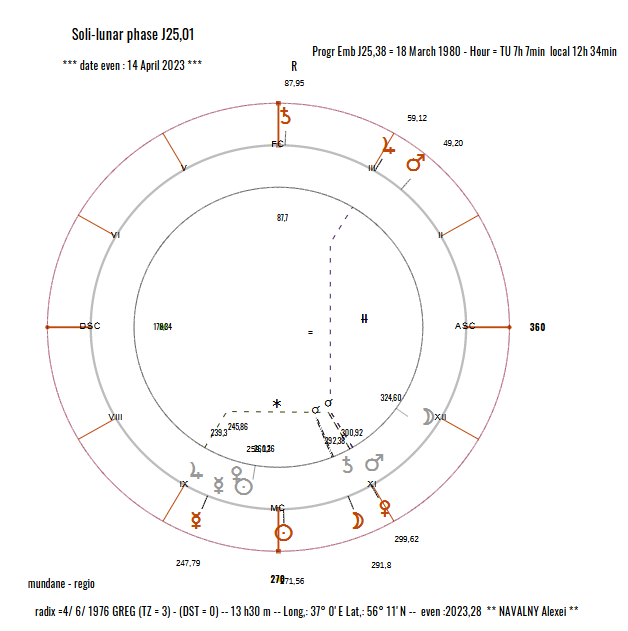
We find a true conjunction between MOp and SAr and another between VEp and MAr. We have also a counter-parallel between MAr and JUp. There is also a counter-parallel between JUr and VEp it is not a * because the mundane distance is 60). So we have a kind of mirror image in this chart.


