Affichage des articles dont le libellé est Soleil-Saturne. Afficher tous les articles

dimanche 13 juillet 2025

LUNI-SOLAR PHASE (2) - Charles V, Holy Roman Emperor

 Charles V, Holy Roman Emperor 

- Luni -Solar phase


Astrologiae ratione and experientia refutatae liber ... by Hemminga, Sixtus (Antverpia, 1583) p. 29.

 Charle Quint
24 Feb 1500 JUL    CAL
monday JUL
radix theme | lat 51° 2' 59" | N 3°43' E E
- LMT -
---------------------------------
natal (bt) 13 h 30 min
raas-rams :23h 48' 9"
reckoned bt Lat --> lmt 4 h 0 min
tu 4h 15' 28"
tsn 14h 49' 16"
---------------------------------
timezone  : 0 
DST : 0 (-)
Equation of time 0h 14' 51"
ΔT 0h 3' 18"
---------------------------------


Luni-Solar phase


We find in the Primum mobile of Placidus the first article devoted to luni-solar progressions. 
The principle is exposed to Canon XL: Progressionibus and the first exemple is given : Index Exemplarum: Caroli V. Austriaci Imperatoris (pp. 59-63) in Tabulae Primi Mobilis etc. (Patavii Mdclvii). 

Here is the "modern" horoscope of Caroli V. I remind you that the aspects between planets and ASC are indicated directly in OA and those between planets and MC are indicated directly in AR. The aspects between planets are indicated in mundo (Regiomontanus).


 This is a method that we find outlined in Vettius Valens [book VI 9] as indicated by Anthony Louis in his blog : 

 'Vettius Valens had a different notion of annual returns. He felt that the return of the Sun each year was insufficient for forecasting for the year ahead because it omitted the influence of the the Sun’s partner, the Moon. As a result, Valens used a hybrid chart for the annual return which consisted of the positions of the planets when the Sun returned to its natal position each year but these positions were placed in a chart whose Ascendant and houses were determined by the moment the Moon returned to its natal degree during the zodiacal month when the Sun was in its birth sign.' [The Tithi Pravesh and its Monthly and Daily Iterations, November 5, 2022] 

Placidus uses it in his Primum mobile (Tabulae primi mobilis cum thesibus et canonibus 1657) and gives the procedure to follow in the XL canon (De Progressionibus, p. 53). A complete example appears in the analysis of the theme of Charles V (Exemplum Primum Caroli V. Austriaci Imperatoris, pp. 59-62). We have redone the placidus calculations with the text below which is closer to its style:

Note that Anthony Louis only gives the soli-lunar return at D0; Placidus continues the progression until end of process (i.e. the even). For example in the case of Charle Quint, if we take the date of 21 Sep 1558, we must first translate this date into 'life-year equivalent': we find :            
---------------------------------------            
EVEN    58,5762012305913    58    Y
                6,91441476709571    6    M
               27,4324430128712    27    D
               10,3786323089089    10    H
                                            22,72    M
---------------------------------------            
The method of “embolismic lunations” as a predictive technique :   See : Tabulae Primi Mobilis,,, Placido De Titis, Patavii, MDCLVII             
An embolismic lunation, correctly termed an embolismic month, is an intercalary month, inserted in some calendars, such as the Jewish, when the 11-days' annual excess over twelve lunar months adds up to 30. An arbitrary application of this was used by Placidus, who applied the term Embolismic Lunation, to a Figure cast for the moment of the Moon's return to the same relation to the Sun that it occupied at birth. It was made the basis for judgement concerning the affairs and conditions of the ensuing year of life.' [https://astrologysoftware.com/community/learn/dictionary/lunation.html]               
The solar year does not have a whole number of lunar months (it is about 365/29.5 = 12.37 lunations), so a luni-solar calendar must have a variable number of months in a year. Regular years have 12 months, but embolismic years insert a 13th "intercalary" or "leap" month or "embolismic" month every second or third year [...]. Whether to insert an intercalary month in a given year may be determined using regular cycles such as the 19-year Metonic cycle [...] or using calculations of lunar phases [...]. [wikipedia]               
The whole difficulty therefore comes from the fact that there is no overlap between the solar month (30 D) and the lunar month (synodic month 29.53), consequently between the solar year (365.242) and the lunar year (354.367).             
 'In Vedic timekeeping, a tithi is a "duration of two faces of moon that is observed from earth", known as milа̄lyа̄ [...] in Nepal Bhasa, or the time it takes for the longitudinal angle between the Moon and the Sun to increase by 12°. In other words, a tithi is a time duration between the consecutive epochs that correspond to when the longitudinal angle between the Sun and the Moon is an integer multiple of 12°. Tithis begin at varying times of day and vary in duration approximately from 19 to 26 hours. Every day of a lunar month is called tithi.' [wikipedia]              
We see that the interest of Placidus' method (outlined by Vettius Valens) comes from the fact that the individualisation structure of the progression system is no longer represented by a single point (solar return or lunar return) but by a distance ( in this case the distance between SU radix and MO radix).            
We find in the literature another method which is similar to that of the solilunar phase: it is the tertiary directions. We find a critique of it in “Les Moyens de pronostic en Astrologie” by Max DUVAL [ed Traditionnelles, 1986, pp. 67-71] and a complete analysis in "A close look at tertiary progressions" by Elva Howson & Jack Nichols, [Considerations, vol XI-4, 1996; pp 3-12]- https://archive.org/details/considerations-21-1/considerations-11-4/page/n1/mode/2up            
In the case of Charle Quint, we observe:            
            
SU radix = 344° 00' 1" (344° PIS)            
            
MO radix = 276° 56' 37"° (276,94° CAP)            
            
∆ = |67° 3' 24"| (67,06° ) [ 5 tithi = ROUNDUP (∆/12)]            
            
Here is now the way in which Placidus would have proceeded: for 48 full years, 44 embolismic lunations are accomplished in 10 years after birth but with 33 days less, that is to say 11*4 since the moon covers 12 lunations in 11 days less than a whole year, as indicated in canon XL            
... if you wish to have a ready calculation of the progressions for several years, note that the moon does not complete twelve lunations in one whole year -i.e. a solar year - but in eleven days less. Having therefore the distance from the moon to the sun in the sky of birth, search for this eleventh day before the end of the first year of life and having found it, then know that the progression of twelve years of life is completed. Likewise 22 days before the end of the second year after birth gives the progressions accomplished for 24 years and so on' [De Progressionibus, op. cit., p. 54]            
Therefore on 24 Feb 1504, by removing 44 days, we arrive at 11 January 1504 [,,,] and then, the process is completed for 44 full years. Then, for the 10 other years elapsed during the twelve embolismic lunations, I arrive at 29 October 1504, for the remaining 9 months and 21 days. I compute the tithi (exact distance between SU and MO radix) for the last time : the date of Embolismic Progression J0 is : 2 November 1504 at 18h 42min tu. Thereafter, i add to this date 17,02 d corresponding to 6,914M [see EVEN] :            
            
JD Pr Emb = 6,91 x 30 / (365.24 /29.53) = 17,02 D            
            
where 365.24 is the number of tropical days in a year and 29.53 is the average period for the synodic month of MO            
            
 trop days 365,242220375371 (1)            
            
syn month = 29,5305877633503 (2)            
            
where T = (JD-2451545)/36525            
            
In the present case JD = 2268986,5            
            
so, T = -4,99817932922656 (see formula 1 and 2)            
            
Finally, we find : date for J17,02D = 19 November 1504 at 19h 4min   local (19h 4min  TU).  Note that 1504 is a leap year ;  so we find the moon's longitude of Placidus by intercaling 1 supplementary day.          
            
---------------------------------------            
(1) exact value for number of tropical days is : 365,2421896698-0,00000615359*T-0,000000000729*T^2+0,000000000264*T³            
(2) exact value for synodic month is : 29,5305888531+0,00000021621*T-0,000000000364*T^2            
The outer circle (in red) represents the arrangement of the planets and houses during the lunisolar cycle; the inner circle (in gray) represents the natal horoscope.            


Some choices (in this case difficulties) are available to us:
1)- Take the planets and longitude houses (zodiacal method) or in domitude (mundane method);
2)- Choose the date D0 (start of the luni-solar cycle) or the due date (here D18).
It seemed more 'natural' to choose the zodiacal method; Experience leads to favouring D0 mode for chronic disease and rather the due date of the current cycle for an accident or acute disease potentially involving the vital prognosis. Only in-depth studies will be able to enlighten us on this ...
We see here that we have choosen the D0 : 
 Charles V has been sick for many years (gout attacks) and had retired to the Yuste monastery, Caceres. In August 1558, Charles was taken seriously ill with what was diagnosed in the twenty-first century as malaria. He died in the early hours of the morning on 21 September 1558.

we find the following aspects (R = radix):
- {♀,☉} ☍ ♄R  ( ♄ being the alchocoden)
- MC ◻ ♄R (mundane ◻ with lunar conjunction)
- ♃ ◻ ♄R (♃ being the dominant -but weak - planet)

We see here the progressions from Placidus (Primum mobile, p. 62) :
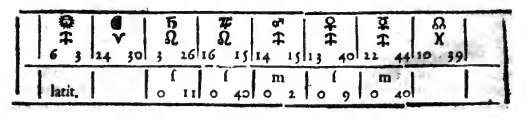

with our result :

We find at D18:

- {♀♂} ◻ ☉R
- ♃ ◻ ♄R (see D0)
- ☉ ◻ ♃R

The result to take in account is : ♂ ◻ ☉R.

These results recall those we have highlighted for the previous theme.


vendredi 11 octobre 2024

Ebn Shemaya (Parkes David)

 Parkes David (Ebn Shemaya)


Author of a thick book, "the star, a system of theoretical and practical astrology" (Cornish, 1838) with the nativity of the author, p. 132.
bibliography : “A” Catalogue Raisonné of Works on the Occult Sciences, Volume 2, Astrological books, Frederick Leigh Gardner, 1911, p. 109

---------------------------------
Parkes David
14 Jul 1811 GREG    CAL
sunday GREG
 | lat 53° 23' 59" | N 0°10' W
0
---------------------------------
natal (bt) 13 h 30 min
raas-rams :23h 54' 36"
reckoned bt Lat --> lmt 22 h 30 min
tu 22h 30' 40"
tsn 17h 57' 20"
---------------------------------
timezone  : 0
DST : 0 (-)
Equation of time -0h 5' 23"
ΔT 0h 0' 13"
---------------------------------

THEME


SU is P with a [-10] score - house rgo 5
MO is E with a [6] score - house rgo 2
ME is T - FA with a [8] score - house rgo 4
VE is P  with a [-12] score - house rgo 3
JU is D with a [-5] score - house rgo 7
MA is Ru with a [10] score - house rgo 3
SA is Fa with a [-6] score - house rgo 9

no point in critical house
no point -
we see below the list of  aspects in mundo :
---------------------------------------
        SU[0,21 Occ 60]JU    MO[3,81 Or 90]ME                    VE[0,4  Or 120]MA          JU[0,37 Or 180]SA
---------------------------------------
The best aspect is  [best :su 60° (0,21) ju]  and the worst aspect is  [worst :ma 120° (0,16) ve]


The traditional almuten (Omar, Ibn Ezra) is JU
we see below the list of dignities for JU :
---------------------------------------
[ term 2 tri 0 rul 1 exn 1 fac 2 ]
[ su 3 mo 2 asc 1 syg 0 pof 0 ]
---------------------------------------
Note 1 : the ‘almuten figuris’ is the lord of the chart, but its determination obeys somewhat different rules according to the schools. The tradition is based above all on the zodiacal dignities. (see p,e,  Alcabitius, Introduction, 59-61, 117 and Avenezra, Nativites, 101) – almuten = al-mu’tazz (arabic term)
[7] As for the governor which is the <planet> predominating (al-mubtazz) over the birth from which one indicates the conditions of the native after the haylāğ and the kadhudāh,n it is the planet having the most leadership in the ascendant, the position<s> of the two luminaries, the position of the Lot of Fortune and the position of the degree of the conjunction or opposition which precedes the birth. When a planet has mastery over two, three or four positions by the abundance of its shares in them, it is the governor and the predominant <planet> (al-mubtazz) and the indicator after the haylāğ and the kadhudāh. From it one indicates the conditions of the native. Some people use it instead of the kadhudāh in giving life.  [Al-Qabisi , Charles Burnett, Keji Yamamoto, Michio Yano, The Introduction to Astrology, IV, 7, p, 117, Warburg, 2004]
Note 2 : There are at least 4 systems for determining the almuten depending on whether the combinations of triplicities and terms are used: the Ptolemaic almuten (followed by Lilly) with Ptolemaic terms ; the same with Egyptian terms; the almuten of Dorotheus with Ptolemaic terms ; the same with Egyptian terms, knowing that one can embellish the whole thing with different weighting system (like Lilly or not using weights like Montanus) [cf. Temperament: Astrology's Forgotten Key, p. 79, Dorian Gieseler Greenbaum 2005]

The Lilly (Ptolemaïc) almuten is ME

In our experience, it seems that Ptolemy's almuten allows one to first appreciate the static side of the natal chart and that the Lilly-type elaboration allows one to deepen the more ‘temporary’ or ‘dynamic ‘ relationships (cf, Shlomo Sela, Ibn Ezra, on Nativities and Continuous Horoscopy, appendix 6, quot 2  ; Horary astrology p, 458, Brill, 2014)
---------------------------------------
Ω  57,41 /
---------------------------------------
the lot of Fortune has been computed according to Placidus's revised method (see 'Primary directions', A primer of calculation by Bob Makransky, 1988, cap X: the Arabian parts, pp. 98-103; see also Mario Fumagalli,  'Il calcolo delle sorti secondo Placido', Linguaggio Astrale 103, June 1996 and 'La sorte oraria, il vero oroscopo lunare.' (Phôs 2, giugno 2001) and Placidus, Coelestis philosophiae, 1675, Brunacci and Onorati ; see finally the english traduction of Placidus, Primum mobile, John Cooper, 1814, Canon of the Part of Fortune, pp, 308-318) ; help will be found also from: : Sepharial, directional astrology, cap XII, the part of fortune, pp, 81-85, 1921 and Oxley Thomas, The Gem of Astral Sciences, cap VII, of the part of fortune or lunar horoscope, pp,45 - 48, 1848)

[Brunacci : 271,84°] the Fumagalli method is the so called horary method from Brunacci and Onorati : we find it in 'De Parte Fortunae Ptolemaica', pp, 8-14 ex libro iii, cap i, in Physiomathematica sive Coelestis Philosophia, Milano, 1675; Cursino Francobacci et Africano Scirata are anagrams for Francesco Brunacci and Francesco Maria Onorati,


HYLEG – ALCHOCODEN – domification ,


In our research, we hypothesised that the mundane chart alone should be considered; also we must base on the aspects taken in the semiarcs the research of the degrees likely to be considered in the duration of the life.
In the case of Parkes David we have the table above which allows us to estimate the breakdown of aspects between the different planets and the alchocoden.
When considering a theme, the first thing is to observe whether it is diurnal or nocturnal. In the case of Parkes David, it is NOCTURNAL.
In this case, the first point to check is SU. If  SU is well disposed, it can claim 1st stage to be HYLEG.

SU is P and therefore seems weak, with a dignity score of [-2],
Moreover, when we look for the dignities that appear in the zodiacal inscription of MO, we find at least one
we find at least one aspect to match with the dignities
We'll see later what we get when we search for mundane dignities.
Now that we know that we cannot consider SU as hyleg, we are left with MO we find aspect to match with the dignities.

If we consider the MUNDANE system, we observe a conjunction aspect of MO.
At the same time, it appears that MO has  dignity of EXN over POF.
So we have two possibilities with our hypothesis : first choose MO for hyleg ; second choose the MUNDANE system and try to find another couple of hyleg/alchocoden,
If we choose now MO we must know that no trad authority agree with this choice
In case of MO is the Hyleg, there is then one candidate to be the alchocoden: MO
First, we have to see which candidate has the most dignity: here, ME has candidate alcho dignities referring to MO : [EXN]
First, MO is linked with MO by a [conjunction] aspect and a [EXN] dignity,
However, MO is [E] and has a power of [8], and so MO has a good Kadkhudah score of [2]
MO is located at 46,54° at 0° (°) from the next (cad) cusp
Now, we have to take account of the radix zodiacal aspects,
------------------------------------------------------
  ME 90 MO: 6,67      minus alcho dy (0)
------------------------------------------------------
Without any change, we find with MO as Kadhkhudah : Y = 66 as a result of MO SUCCEDENT years
But as MO is EXN, following William Lilly in Christian astrology, p, 115 (London, 1647) on his table of Fortitudes and debilities, we remove 1/5 of his value, as dignity for MO is    E     Or  (ie 0)
------------------------------------------------------
So, zodiacal Y =80,31

Primary direction at death (1906)


David Parkes died at a very advanced age (95 years) for his time. The factors found are: MO in CAN (EXN), VE in lower culmination.

We find two directions :

1) a converse direction from SU to SA, in REGIO.


speculum Lat Dec AR MD SA HA
SU - 21,74 N 113,23 156,11 D 122,48 D -33,63 W
CSA -2,37 S -21,9 S 260,67 8,66 D 57,22 D 48,56 W
– MD = meridian distance (from MC if SA f [SU]  is diurnal or IC if Sa f  is nocturnal)
– SA = semi-arc (if f is diurnal, SA f [SU] is D and all MD’s and SA’s are D, otherwise N)
– HA = horizontal distance (from the nearest horizon W or E for f [SU] and m CSA)
under bracket [] the fixed point, (here SU)
- Lat CSA -2,37 S and lat SA : 1° 16' 41"


TABLE of AO and DO AO DO AO DO

1 2 3 4
A1 SU

+
AO ±

-
A2 CSA
+

AO ±
-

AO SU

136,36
DO SA / pole SU
237,34

DO SA
250,72

AO SU / pole SA

123,10


AO DO AO DO


AR-DA AR-DA

The only tricky point to take into account is to highlight whether the key points (SU and SA) should be considered in OA (oblique ascension) or OD (oblique descension). The values ​​of AO and DO will be obtained from the RA and the DA of the star, applying the following formulas:

for a star with positive declination (North)
AO = RA - DA
DO = RA + DA
for a star with negative declination (South)
AO = RA + DA
DO = RA - DA

You also see that the rule is double and does not include the sign of DA (ascensional difference). The table above summarises these observations.

DP REGIOMONTANUS (5)

DP REGIO-CAMPA D
DP REGIO-CAMPA C

DIRECTIO CONVERSA A2 CSA A1 SU A1 SU A2 CSA A2 CSA A1 SU
Tan A tan dec/cos dm
23,56
-22,13

B (1) +LG-A or -LG+A
-76,96
75,53

Tan C cot DM.cos B/cos A
-29,06
-60,54

Sin pole (2) Cos C.sin LG
44,57
23,26

Sin DA (3) Tan pole A1.Tan Dec A2
Tan pole A2. Tan Dec A1
DAP (6) 23,13 -23,33 -9,95 9,87
AO (4) AR ± DA
136,35 237,34 250,72 123,09
Arc (7) AO1 – AO2

-100,99
127,63


DIRECT
CONVERS
(1) B must be treated as positive number
(2) sign of pole has the same sens of LG for DA Here, DA = DA/pole A
(3) sign [-] if pole and Dec have the opposite sign – sign [+] if planet located in western half, sign [-] if planet located in eastern half ; Signs [+] and [-] must be reversed for births in the southern hemisphere
(4) to find AO of a star A2 under the pole of A1, we calculate the  DA of A2 under the pole A1 ex: tan pôleA1.tan DecA2=sin DA A2/poleA1
(5) algorithm and lessons from : a)- Gouchon (‘Dictionnaire astrologique’, Dervy, 1946, 1975, p, 276, attributed to H. Selva) ; b)- Martin Gansten (‘Primary directions’, pp, 155-157, 2009, Wessex Astrologer) - instructions for use only appear in Gansten – c)- Astrologia gallica, Morin de Villefranche, trad Holden (appendix 5, pp, 151-153) ; d)- Henry Coley, Clavis astrologiae elimata, 1676, pp. 609-648 ; e)- Henri Selva, La domification, Vigot, 1917, reprint Lacour 1992, p, 25 and 131
(6) ascensional difference under own pole
(7) if the 0° point of the equator (viz 0° trop ARI) should fall between one of the two points, 360° must be added to arc


The clearest and most complete exposition I know can be read in:
- Delambre (about Magni)
- Selva (about the regiomontanus directions)

arc = 100.99 (regio)
conversion for key BRAHE : even (94.92) x 1.048 = 99.5
diff = 1.49

We can also use the formula from 'Casting the horoscope' from Alan Leo (but I doubt he is the author) :

REGIOMONTANUS C SA SU
(a) 8,03 22,10 Sina = cos dec x sin MD
(b) -247,87 113,57 tan b (b') = cot dec x cos MD (***)
(c) 0,56 -1,80 X = tan a x cosec (latgeo +b (b'))
PM 18,62 47,04 Tan PM regio = tan(X x cos(latgeo))
(mod ∟) 251,38 137,04 dom regio
house 9 5

11,38 [ d, IX ] 17,04 [ d, V ] domitude
(**) 23,26 44,58 pole regio
A cosA=tanp/tanλ 42,96 ∠ meridian↑ p/λ
B 66,66 cosB=-tanp tanδm SA D C SA / pole 44,58
Arm 260,67
AR C SA
TS 269,334
AR MC


3|Occ 100,95 B+A±(TS-Arm) pf Occ N - pm Occ D


quadrant SU arc formula (mod 360°) orient pf – pm
even 94,92

EQU | arc =1,048 99,50
DA [C SA] with δ C SU 23,14
≠ PLACIDUS -22,05
DA [C SU] with δ C SA -23,34
≠ REGIO -1,45
SA D prom [C SU] with δ C SA 66,66
(*) Sepharial (Walter Gorn Old), cuspal distances, debatable ground, the horoscope, 2, 5, 19-23, Oct 1903
directional astrology, p, 72, Sepharial, 1921
(**) according to Max Duval, ''Les Moyens de pronostic en astrologie', pp 11-15, direct zodiacal directions, Ed Traditionnelles, 1986
(***) if 0<b<90;b=b' ; if 180<b<90; b'=180-b (use sign of b)
cf, Alan Leo, Casting the horoscope, (Astrology for all, II,, appendix, pp 180-183, L. N. Fowler & Co., London, 1912)

We see that the interest of this last method is that it allows to place in a first time the PM (in mundo positions) and therefore, to determine the Regio domitudes (and Campanus not noted here). We use in a second time the formulas given by Max Duval. The poles are determined from the PM.

mercredi 2 octobre 2024

Robert Cross Smith

 Robert Cross Smith (1795-1832) was an English astrologer, writing under the pseudonym of "Raphael".


There is a series of small monographs - often unintentionally humorous (sic) - in the journal 'Modern Astrology' (series the Astrologers magazine, vol II, 1891-1892, pp. 294-296) particularly on the life of Sibly; we give it below with annotations.


ASTROLOGICAL students, and all others who maybe interested in the science, owe a debt of gratitude to two men whose names, or rather noms de plume, have become household words, and justly so, for it is due to their efforts that the science holds its present position. Up to the time of their labours Astrology had degenerated to a mere form of predicting, of a very low order ; its truths had been obscured by rubbish. These two men came, and, to a great extent, cleared the obstacles from the path by the publication of their works, and we, in this 19th century, have reaped the benefit. These are "notable" men in every sense of the word, and it is but fitting that their horoscopes should be in the hands of every astrological student, and we should be doing injustice to their memory if we did not include their horoscopes in our columns. Commander R. J. Morrison, R.N., or " Zadkiel," the name he is generally known by, is the author of " The Grammar of Astrology," and the founder of the almanack that bears his name. He likewise produced a modern edition of Lilly's " Christian Astrology " (the horary part), besides many other works on Astrology.
His contemporary, R. C. Smith, or "Raphael," (1) is the author of several works, the best of which is undoubtedly " The Manual of Astrology." He also produced an almanack which bears his nom de plume. His horoscope follows ;  that of Commander Morrison will appear later. Both of these are " notable" men and will be revered by all Astrologers.
RAPHAEL was born under the 19th degree of the celestial sign Gemini, a sign noted for the number of fixed stars of the first magnitude therein. His significator is Mercury (2), who is just entering the notable sign Aries, in conjunction with the solar orb, and beneficially configured with the two superior planets Saturn and Jupiter, but in ill aspect with Venus (semi-square). Venus is culminating in' a sign I consider peculiarly suitable to Mercury ; this position would give him popularity, but the ill aspect to his significator would cause much ill-feeling on the part of certain members of the opposite sex, and who would somewhat affect his honour and reputation. He was a true " son of Mercury," which his numerous writings bear testimony to, the good aspect to Saturn giving him that patience so necessary when making researches and experiments, and the good aspect to Jupiter giving that high moral tone which permeates the whole of his writings. Three planets in fixed signs gave him his determination, the parallel of Moon and Uranus the originality that bore chiefly on the occult, the force and energy that characterised his studies and publications on astral philosophy emanating from Mars' trine aspect to Uranus, assisted by the Moon's parallel to them both ; whilst the Moon, in a fruitful sign near the cusp of the eleventh, produced him many friends, yet as she separates from the opposition of Uranus, he would experience annoyances at the hands of many so-called occultists, who doubtless were jealous of his popularity, from the fact of Saturn squaring Uranus both from earthy signs.
I judge his financial affairs were not very grand, although the Sun and Saturn are in good aspect to Jupiter. Mars upsets their good intentions by an evil square, and he also afflicts the Moon, who rules his house of finance. Space forbids further elucidation, I therefore leave the natus of this worthy apostle of astral science for the student's closer investigation.

'Smith died just as he was planning to move to another publisher for The Prophetic Messenger as he was paid a fixed sum, whatever the sales were, which were steadily increasing. In 1831 he moved to 75 Castle Street and fell ill "caused by much study". He spent a bad winter suffering from a violent cough and frequent fits. He died at 16:15 on 26th February 1832 of consumption.'
[https://www.skyscript.co.uk/raphael.html]

(1) Raphael I ; Mr. John Palmer (1807-1837), who succeeded R.C. Smith as Raphael II and is copied from the "Prophetic Messenger for 1837. There are no fewer than 7 astrologers who have taken the nom de plume Raphael (cf. https://www.astro.com/astrowiki/de/Raphael).
(2) it seems that JU is the alchocoden (SU is the hyleg). ME is combust

---------------------------------
Cross Robert
19 Mar 1795 GREG CAL
thursday GREG
| lat 51° 27' 0" | N 2°35' W
0
---------------------------------
natal (bt) 13 h 30 min
raas-rams :23h 52' 0"
reckoned bt Lat --> lmt 9 h 15 min
tu 9h 15' 0"
tsn 20h 51' 56"
---------------------------------
timezone : 0
DST : 0 (-)
Equation of time -0h 7' 59"
ΔT 0h 0' 16"
---------------------------------


list of mundane aspects 
--------------------------------------------------
SU[-0,48 Occ 0]ME                          ME[-7,28 Occ 60]JU    VE[8,37  Or 60]MA 
--------------------------------------------------
The score of engaged aspects with ME is explained by the bad values ​​of ME in the celestial and zodiacal rankings.
Note that the axial aspects are already in AO with ASC and AR with MC
--------------------------------------------------
HYLEG – ALCHOCODEN – domification ,

In our research, we hypothesised that the mundane chart alone should be considered; also we must base on the aspects taken in the semiarcs the research of the degrees likely to be considered in the duration of the life.
In the case of Cross Robert we have the table above which allows us to estimate the breakdown of aspects between the different planets and the alchocoden.
When considering a theme, the first thing is to observe whether it is diurnal or nocturnal. In the case of Cross Robert, it is DIURNAL.
In this case, the first point to check is SU. If  SU is well disposed, it can claim 1st stage to be HYLEG.

SU is P and therefore seems weak, with a dignity score of [-1],
But, when we look for the dignities that appear in the zodiacal inscription of SU, we find none.
we find none aspect to match with the dignities,,,
We'll see later what we get when we search for mundane dignities.
So : the hyleg is SU as dignity is P and aspect is conjunction


Now we must look for the alchocoden: it is the planet which has the maximum dignity with regard to the hyleg and which exchanges a Ptolemaic aspect with the hyleg.
if we consider the MUNDANE system, we observe a conjunction aspect of JU.

So we have two possibilities with our hypothesis : first choose SU for hyleg ; second choose the MUNDANE system and try to find another couple of hyleg/alchocoden,
If we choose now SU we must know that no trad authority agree with this choice
In case of SU is the Hyleg, there is then 0
First, we have to see which candidate has the most dignity: here, JU has candidate alcho dignities referring to SU : [TRI]
First, JU is linked with SU by a [conjunction] aspect and a [TRI] dignity,
However, JU is [P] and has a power of [-3], and so JU has a bad Kadkhudah score of [6]
JU is located at 300,92° at more than 5° from [Δ degrees cups sup [IX] : 11,89° (240)] and has a domitude Regio of : [251,89] for a latitude of [-0,27°]

THEME

SU is P with a [-3] score - house rgo 11
MO is T with a [10] score - house rgo 11
ME is D cb with a [-23] score - house rgo 11
VE is te  with a [9] score - house rgo 10
JU is P with a [-11] score - house rgo 12
MA is Ru with a [5] score - house rgo 9
SA is T with a [2] score - house rgo 12

points to specially watch for the duration of life: 0 in house VI ; MA SA in house XII
points to specially watch for the social destiny: VE  in house X
we see below the list of  aspects :
---------------------------------------
  SU[-0,48 Occ 0]ME                          ME[-7,28 Occ 60]JU    VE[8,37  Or 60]MA          
---------------------------------------


The traditional almuten (Omar, Ibn Ezra) is VE
we see below the list of dignities for VE :
---------------------------------------
[ term 3 tri 0 rul 1 exn 2 fac 3 ]
[ su 1 mo 3 asc 2 syg 1 pof 0 ]
---------------------------------------
Note 1 : the ‘almuten figuris’ is the lord of the chart, but its determination obeys somewhat different rules according to the schools. The tradition is based above all on the zodiacal dignities. (see p,e,  Alcabitius, Introduction, 59-61, 117 and Avenezra, Nativites, 101) – almuten = al-mu’tazz (arabic term)
[7] As for the governor which is the <planet> predominating (al-mubtazz) over the birth from which one indicates the conditions of the native after the haylāğ and the kadhudāh,n it is the planet having the most leadership in the ascendant, the position<s> of the two luminaries, the position of the Lot of Fortune and the position of the degree of the conjunction or opposition which precedes the birth. When a planet has mastery over two, three or four positions by the abundance of its shares in them, it is the governor and the predominant <planet> (al-mubtazz) and the indicator after the haylāğ and the kadhudāh. From it one indicates the conditions of the native. Some people use it instead of the kadhudāh in giving life.  [Al-Qabisi , Charles Burnett, Keji Yamamoto, Michio Yano, The Introduction to Astrology, IV, 7, p, 117, Warburg, 2004]
Note 2 : There are at least 4 systems for determining the almuten depending on whether the combinations of triplicities and terms are used: the Ptolemaic almuten (followed by Lilly) with Ptolemaic terms ; the same with Egyptian terms; the almuten of Dorotheus with Ptolemaic terms ; the same with Egyptian terms, knowing that one can embellish the whole thing with different weighting system (like Lilly or not using weights like Montanus) [cf. Temperament: Astrology's Forgotten Key, p. 79, Dorian Gieseler Greenbaum 2005]

The Lilly (Ptolemaïc) almuten is VE

In our experience, it seems that Ptolemy's almuten allows one to first appreciate the static side of the natal chart and that the Lilly-type elaboration allows one to deepen the more ‘temporary’ or ‘dynamic ‘ relationships (cf, Shlomo Sela, Ibn Ezra, on Nativities and Continuous Horoscopy, appendix 6, quot 2  ; Horary astrology p, 458, Brill, 2014)
---------------------------------------
Ω  173,59 / -3
---------------------------------------

the lot of Fortune has been computed according to Placidus's revised method (see 'Primary directions', A primer of calculation by Bob Makransky, 1988, cap X: the Arabian parts, pp. 98-103; see also Mario Fumagalli,  'Il calcolo delle sorti secondo Placido', Linguaggio Astrale 103, June 1996 and 'La sorte oraria, il vero oroscopo lunare.' (Phôs 2, giugno 2001) and Placidus, Coelestis philosophiae, 1675, Brunacci and Onorati ; see finally the english traduction of Placidus, Primum mobile, John Cooper, 1814, Canon of the Part of Fortune, pp, 308-318) ; help will be found also from: : Sepharial, directional astrology, cap XII, the part of fortune, pp, 81-85, 1921 and Oxley Thomas, The Gem of Astral Sciences, cap VII, of the part of fortune or lunar horoscope, pp,45 - 48, 1848) 

[ ⊕ Brunacci : 65,01°] 

the Fumagalli method is the so called horary method from Brunacci and Onorati : we find it in 'de parte fortunae ptolemaica, pp, 8-14 ex libro iii, cap i, in physiomathematica,,, cursino francobacci et africano scirata are anagrams for francesco brunacci and francesco maria onorati,

Primary directions

1)- direction directa : ☌☉ ☌♄

This direction is one of the most classic relating to the somatic aspect of a person. It seems that Cross was seriously ill as early as the autumn of 1831. At that time, we note in the placidus direction (Brahe key) an arc of 33.57 which leads to an orb of 3.67 Y. In the Regio direction, the arc is 31.49 with an orb of 5.75 Y. If we take the Placidus step, we note in the placidus direction an orb of -0.73 Y and in Regio, an orb of 2.81 Y.


2)- directio conversa : [c] ☌♂ ◻♀

This is a true converse direction, that is to say that the planet (MA) is "dragged" towards the eastern square of VE. This "dragging", once again, is only the apparent result of the primum mobile.

speculum Lat Dec AR MD SA HA
MA -0,03 S 10,57 N 25,56 107,43 N 76,45 N -30,98 W
□VE 0 S 22,99 N 77,86 55,12 N 57,82 N 2,7 W

– MD = meridian distance (from MC if SA f [MA]  is diurnal or IC if Sa f  is nocturnal)
– SA = semi-arc (if f is diurnal, SA f [MA] is D and all MD’s and SA’s are D, otherwise N)
– HA = horizontal distance (from the nearest horizon W or E for f [MA] and m □VE)
under bracket [] the fixed point, (here MA)
- Lat □VE 0 S and lat VE : 1° 40' 48"

--------------------------------------------------------------------------

PLACIDUS CUSPAL DIST (*) □ VE MA PLAC DIR – POLE
directio conversa OA ASC 42,99 signif promissor □ VE [E] | MA [E]

OA □ VE 45.66 OA OA asc or desc

dist horiz 2,70 4 1 □ VE under earth |
MA above earth

house □ VE 1 □ VE [MA 103,55 D]


horary time (ht) 9,64 57,82 90 pole □ VE

double ht 19,27 55,12 85,80 50,25
houses
33,01 DM PM
1 1,00 33,01


2 0,67 22,00
DA MA / □ VE OA MA / □ VE

pole 2 40,80 51,45 21,92 55,95

dec □ VE 22,99

OA MA

DA □ VE /2 21,49 32,18 9,45 16,11

RA □ VE 77,86
5,19 39,84

OA 56.37 110,04
dir

dist □ VE cusp / 2 10,69 8,58 19,27

(*) Sepharial (Walter Gorn Old), cuspal distances, debatable ground, the horoscope, 2, 5, 19-23, Oct 1903
directional astrology, p, 72, Sepharial, 1921
(**) according to Max Duval, 'Les Moyens de pronostic en astrologie', pp 11-15, direct zodiacal directions, Ed Traditionnelles, 1986
(***) if 0<b<90;b=b' ; if 180<b<90; b'=180-b (use sign of b)
cf, Alan Leo, Casting the horoscope, (Astrology for all, II,, appendix, pp 180-183, L. N. Fowler & Co., London, 1912

arc = 39.84 (corresponding to 40.16 with Brahe key)

δ 22,99 10,57
REGIOMONTANUS □ VE MA
(a) 49,04 69,70 Sina = cos dec x sin MD
(b) 126,58 58,06 tan b (b') = cot dec x cos MD (***)
(c) 33,55 -2,87 X = tan a x cosec (latgeo +b (b'))
PM 87,26 60,78 Tan PM regio = tan(X x cos(latgeo))
(mod ∟) 2,74 330,78 dom regio
house 1 12

2,74 [ d, I ] 0,78 [ d, XII ] domitude
(**) 51,42 47,60 pole regio
A coA=tanp/tanλ 29,22 ∠ meridian↑ p/λ
B 117,70 cosB=-tanp tanδm SA D □ VE / pole 47,6
Arm 77,86
AR □ VE
TS 312,986
AR MC
1 36,40 (ARm-TS) ± A-B pf Or N - pm Or N


quadrant MA arc formula (mod 360°) orient pf – pm

This calculation method was inspired by an article found in 'Casting the horoscop' by Alan Leo entitled 'How to find the Mundane Positions'.


'In the diagram HAZA' is the meridian, HOA' is the horizon, O the centre, Z the zenith, OEq the equator, and A the North Pole. The position of the star is represented by a large dot, and is shown in two positions B and B' with respectively S. and N. declination. AB'B is a declination circle drawn from the N. Pole through the star. The figure is drawn for a place in the northern hemisphere, and shows the star in a position between the cusps of the seventh and tenth houses. By suitable modification the figure can be adapted to a place in the southern hemisphere, or for a star in some other quadrant. Two House Position Circles are shown A'BDEH and A'D'B'E'H, such as the star would have with a given declination, either S. or N. The arcs BC, B'C' are arcs of great circles, and are therefore NOT parallel to the equator; but they are drawn such that the angles at CC' are right angles, a fact which it is important to bear in mind; but AB'C', ABC are NOT right angles.

(i) The CAMPANUS house-position will be shown by the arc ZE or ZE' which shows the distance of the House Position Circle from the Zenith measured along the Prime Vertical ZE'EO.
(ii) The REGIOMONTANUS house-position will be shown by the arc EqD or EqD' which shows the distance of the House Position Circle from the meridian measured along the Equator ODD’Eq. The angle BAC or B’AC' shows the M.D. of the star.' [Alan Leo, 'Casting the horoscope', Appendix, Determination of planets' mundane positions, pp. 180-181, London, 1912]

The arcs EqD or EqD' which show the distance of the House position circle are the ET arcs that we see in the Delambre's figure 129 of the 'Histoire de l'Astronomie du moyen âge',  pp, 486-491 (which are an explanation and development of Magin's ideas from Primum mobile duodecim libris,,, 1609).

EqD = ET = cot[sin(∆AR,AR')/sin(P)]+cot(P) = PM = tan(𝛑p)/tan(𝝀)

where ∆AR = DA from significator or promissor, P = horary angle , 𝛑p = pole REGIO of star, 𝝀 = lat geo, pm = mundane REGIO position.

from Delambre, fig. 129, here ET = 87.26, PM of ♂.


From the PM, we recover the domitudes: dom regio = 270 (90) ± PM (modulo quadrant) and the Regiomontanus poles.

We can thereafter use the formulas to find the Regio arc :

arc =36.4 (with the Brahe key, 36.7 Y).

3)- directio directa : ◻♄ ☌☽

speculum Lat Dec AR MD SA HA
MO -2,5 S -11,44 S 339,24 26,25 D 75,29 D 49,04 W
□SA 0 S -19,35 S 305,99 7 D 63,85 D 56,85 W

– MD = meridian distance (from MC if SA f [MO]  is diurnal or IC if Sa f  is nocturnal)
– SA = semi-arc (if f is diurnal, SA f [MO] is D and all MD’s and SA’s are D, otherwise N)
– HA = horizontal distance (from the nearest horizon W or E for f [MO] and m □SA)
under bracket [] the fixed point, (here MO)
- Lat □SA 0 S and lat SA : -1° 50' 43"

-------------------------------------------------------------------------------

MAGINI – REGIOMONTANUS    
direct    
    
    
modified from [ Delambre, Hist Astron Moyen Âge, Magini, pp, 486-491 Paris 1819]    Eq for Fig 129 (pl 12)  see fig for location and explanation of spherical triangles
    
    h (altitude  of the promissor) - H (latitude of the observer) - D (declination of the promissor) –
    D' (declination of incident horizon = position circle of promissor) - PH=H -
    
aspect [□ SA] orient control    control pole (0,1)
-1    0

P (horary angle, from midnight)    
-7,00    ||  cosP = (sinh-sin Hsin D)/(cosHcosD)
353,00    
PHA (HAO angle)    
-14,59    ||  TanPHA = sinP/((sinDA[MO]+cosP)cosH)
------------------------------------------    
PR (pole HAO)    DA [□ SA] with δ C MO -2,99
-11,365    ||  sinPR=sinPHsinPHA
DA [C MO] with δ □ SA -5,45

ET (arc meridian/HAO)    SA D prom [C MO] with δ □ SA 84,55
167,55    ||  tanET=cosHtanPHA

------------------------------------------    MAGINI – PROBLEMA XVI
H'    ||  H' (incident horizon = B50
15,14    ||  tanH'=sinETtanH
------------------------------------------    
PAR (position angle)    
16,07    ||  sinPAR=sinH'/cosD
    
QS, HPR (Az PR)    
77,55    ||  cosQS=sinET
    
ΔAR' (DA/HAO)    #VALEUR !
-5,45    ||  sinΔAR'=tanDtangH'
    
OTE, HTQ, ETH (equat/HAO angle)    
74,86    ||  tanOTE=cotH/sinET
------------------------------------------    MAGINI – PROBLEMA XVII
KO (≠AR □ SA C MO)    Eq for Fig 130 (pl 12) see fig for location and  Explanation of spherical triangles
34,61    ||  KO=AR□ SA - ARC MO
------------------------------------------    
A (AET angle)    ||  EA = 90-H
19,51    ||  sinA=sinETsinOTE/sinEA
    MAGINI – PROBLEMA XVIII
T (angle horizon/OTH)    ||  pole of PRS (=90-H')
74,86    ||  cosT=sinAETsinH
    
[+] TO ΔAR' □ SA    ||  D austral --> sign OT [-]
-5,45    ||  sinTO=tanDcotT
1    -
[-] TV ΔAR' C MO    ||  D' austral-> sign TV [+]
-2,99    ||  sinTV=tanVZcotT
-1    +
tasyir    ||  If OS (D) [+], TO ~ sign,  If RK (D') [-], TV ~ sign
37,07    ||  KV=KO – OT – TV
    
VZ    ||  D' (declin of C MO)
-10,90    
    
OS    ||  D (declin of □ SA)
-19,35    
    
ST    distance ST
-20,08    ||  sinST=sinD/sinT
    
TZ    distance TZ
-11,30    ||  sinTZ=sinD'/sinT
    
ZS    ≠dist
-8,78    ||  If D/D'<0 [-]
    
EPA (EPV, EV) ± ΔAR'    horary angle of □ SA
173,00    ||  if d is [-] ~ ΔAR'
    
IOANNIS ANTONII MAGINI  PRIMI MOBILIS LIBER NONUS QUI AGIT DE DIRECTIONIBUS pp, 214-232 PROBLEMA XVI p, 229 – PROBLEMA XVII p,229  PROBLEMA XVIII p, 230 Venezia: Damiano Zenaro. 1604    
    
KV = KO [-] TO [+] TV    
37,07    ||  KV = KO [+] TO ΔAR' □ SA [-] TV ΔAR' C MO
2,47    ≠AR'

arc = 37.07 Y.

Problem XVI gives the means of finding if a star is in the same circle of position, with a planet or any significator. Find the arc position ET, which assumes the hour angle of the star and its semidiurnal arc. With ET and H you will have the angle O of the position circle with the meridian; you will compare this circle to that of the significator and you will see if it differs from it. Problem XVII. The significance being placed in any angle, direct or lead him to the promissor, following the order of the signs. He [Magini] calls, following the usage of astrologers, significator, the one who holds the first place in the zodiac, and promissor, the one who holds the second place according to the order of the signs.  To direct means to seek the arc of the equator which, by the movement of the sphere, while the promissor will be transferred to the position of the first, that is to say of the significator, will pass through the meridian or through the horizon, if it is in one of these circles, or through the circle of position of the significator, if it declines from one of these angles. We have already seen that astrologers counted four angles; the angle of the east and that of the west, that of the upper meridian and that of the lower meridian; that is to say the two points of the ecliptic which are on the horizon and the two which are at the meridian. The angle of the upper meridian was also called the middle of the sky, that of the lower meridian was still called the bottom of the sky. This problem, quite complicated, depends only on the most ordinary rules of spherical trigonometry. 


Problem XVIII. Wherever the signifier is, outside the angles from the meridian and the horizon, lead him to any promissor, following the order of the signs, by the rational path. The operation, says Magini, is very painful. You must have right ascension and the distance to the meridian, both of the significator and the promissor; their declinations and the semi-diurnal or semi-nocturnal arc, depending on whether it is above or below the horizon; it is necessary to find the elevation of the pole on the position circle and the position arc. We reported the necessary formulas for all these calculations. Then let S be the significator, R the promissor (fig. 130), RZN the parallel of the promissor, OK the difference of  right ascensions; R will cross the ASC position circle in Z; K.V will be the movement of the equator, which will take R to point Z; the time interval will be therefore measured by  KV = KO — OT — TV = direction,  These last problems bring the theory of directions into the greatest light ! This theory belongs exclusively to the Middle Ages. No one has exposed it as completely as Magini.