Affichage des articles dont le libellé est Centum Geniturarum. Afficher tous les articles

mardi 26 septembre 2017

GALEAZZO SFORZA

HIERONYMI CARDANI - DE EXEMPLIS CENTUM GENITURARUM


XLIV

[[Junctinus, 428b ; Cardano 482 ; Garcaeus 383b]

GALEAZ SFORCIAE (1444-1476)


1)- introduction


Horoscopes could also be found in miscellaneous manuscripts, and much more rarely, they could constitute the core of a single manuscript containing a detailed interpretation. This is the case of Ms Trivulzianus 1329, a beautifully illuminated presentation copy of a indicium, namely a lengthy interpretation ofGaleazzo Maria Sforza’s own geniture. With its sixty-three folios, this parchment manuscript is possibly the single lengthiest astrological interpretation of a fifteenth-century horoscope still preserved. It is certainly one of the most remarkable examples of the fine intricacies and the sheer complexity of Renaissance astrology. Like many other prominent rulers of this time, Galeazzo Maria Morza had his own natal horoscope cast by an astrologer looking for permanent employment. Its author was the physician-astrologer Raffaele Vimercati, who probably studied medicine and astrology at the local university of Pavia. The work was composed sometime before the summer of 1461. The text contained a wealth of information that was deemed relevant to the life of the young duke and could help him foresee and prevent future difficulties and dangers, both personal and political.


Raffaele Vimercati donating his iudicium to Francesco Sforza, first duke of Milan. In MS Triv. 1329, Liber ludiciorum in Nativitate Comitis GaleazMarie Vicecomitis Lugurum futuri ducis. 1461, fol. 2r.

Writing such a lengthy iudicium was no trivial matter. It required a high level of competence in astronomical computation and astrological interpretation, and it would take days to be produced. The first step in casting a geniture was to produce an accurate chart (Fig. 3). Vimercati did this admirably, going through a series of very intricate calculations in order to rectify the chart and obtain the most accurate celestial figure. He did so by applying the Arabic theory of animodar, a complex series of calculations to gain higher precision as to the time of birth. Aware that an incorrect chart would lead to erroneous or questionable interpretations, he took pains to provide accurate calculations. [The Politics of Prognostication: Astrology, Political Conspiracy and Murder in Fifteenth-Century Milan, Monica Azzolini, pp. 10-13, excerpts, in History of Universities: Volume XXIII/2, Mordechai Feingold 2008]

Garcaeus, center of Sforzia genitura, Astrologiae methodus, 383


There were three principal assassins involved in Sforza's death: Carlo Visconti, Gerolamo Olgiati and Giovanni Andrea Lampugnani, all fairly high-ranking officials at the Milanese court.
Lampugnani, descended from Milanese nobility, is recognized as the leader of the conspiracy. His motives were based primarily on a land dispute, in which Galeazzo had failed to intervene in a matter which saw the Lampugnani family lose considerable properties. Visconti and Olgiati also bore the duke enmity - Olgiati was a Republican idealist, whereas Visconti believed Sforza to have taken his sister's virginity.
After carefully studying Sforza's movements, the conspirators made their move on the day after Christmas, 1476, the official day of Santo Stefano, the namesake of the church where the deed was to be committed. Supported by about thirty friends, the three men waited in the church for the duke to arrive for mass. When Galeazzo Sforza arrived, Lampugnani knelt before him; after some words were exchanged, Lampugnani rose suddenly and stabbed Sforza in the groin and breast. Olgiati and Visconti soon joined in, as did a servant of Lampugnani's.
Sforza was dead within a matter of seconds. All the assassins quickly escaped in the ensuing mayhem save for Lampugnani, who became entangled in some of the church's cloth and was killed by a guard. His body soon fell into the hands of a mob, which dragged the corpse through the streets, slashing and beating at it; finally, they hung the body upside-down outside Lampugnani's house. The beheaded corpse was cut down the next day and, in an act of symbolism, the "sinning" right hand was removed, burnt and put on display.


2)- natal chart


Unlike Vicomercati, I did not correct the time of birth and I took that given by Garcaeus, 3:15, which corresponds approximately to that indicated by Cardano (9h 10 horologia).

  • ASC SAGIT, ruler JU (VII, exil) - MO (I)
  • MC  SCORPIO, ruler MA  (IX)

- HYLEG : MO
- ALCOCODEN : VE (sextil ASC, MO)
- ANAERETA : SA, MA

Morinus gaves JU as ALMUTEN... It seems that both SU and JU are detrimental. And we have a conjunction SU-VE. We have also an opposition MO-JU and a quadrat MA-JU.

3)- primary directions


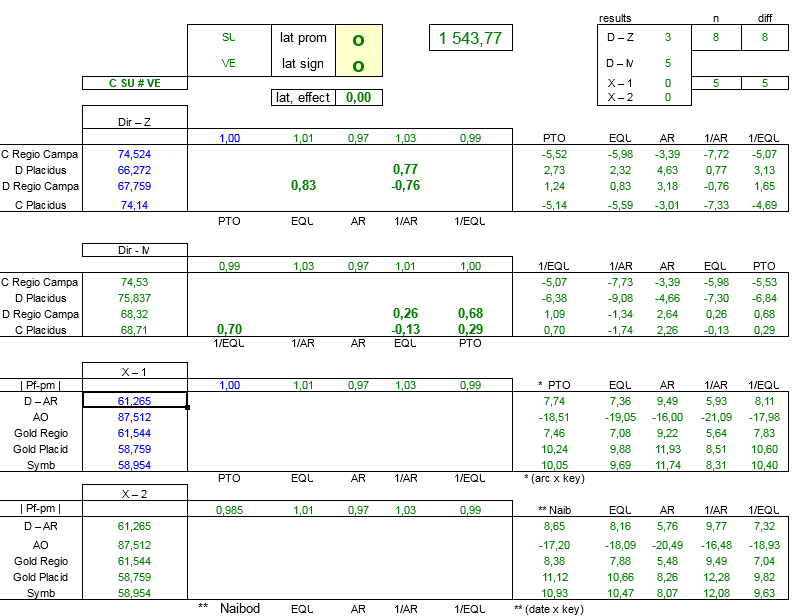
 We see 3 directions : #MO conj SA ; SA conj #MO and #MA conj VE. So, at the time of the assassination, three prominent directions were in orb: they involved both hyleg and alcocoden.

a)- #MO conj SA 


1 Regio-Campa.

b)- SA conj #MO


2 directions Placidus and Regio for this ray.

c)- #MA conj VE


We find 2 Regio-Campa and 3 Placidus directions.

conclusion


The length of life could be calculated from the natal horoscope following a complex series of calculations and manipulations. This practice conformed to a specialized technique called prorogation, which had been codified by Ptolemy in classical antiquity and further developed by Arabic astrologers in the Middle Ages. In Tetrabiblos III. 10, Ptolemy had likened the lifespan of man to an arc of the celestial ecliptic. The arc would start at a particular point on the ecliptic, the hyleg (the planet or point considered to be the ‘giver of life’ in the chart). From there the life would be cast forward with a greater or lesser force, depending on the strength of the alchochoden (the planet that was deemed to be ‘the giver of the years’). This trajectory could be arrested or reduced in length by encountering one or more destructive points or planets met in its trajectory. All these factors, considered together, would determine the actual lifespan of a person. Having established that Jupiter, the alchochoden in Galeazzo’s chart, was in a particularly favourable position, Vimercati concluded optimistically that, ‘unless the misfortunes of the hyleg make them shorter’, the duke of Milan would live eighty-one years and eleven months. [The Politics of Prognostication: Astrology, Political Conspiracy and Murder in Fifteenth-Century Milan, Monica Azzolini, pp. 13-14, excerpts, in History of Universities: Volume XXIII/2, Mordechai Feingold 2008]

We have seen that the alcocoden could not be judged by his celestial state (exile). Only VE (contracting a * with AS, MO) can claim this state.

samedi 23 septembre 2017

GALEAZZO CAPRA

HIERONYMI CARDANI - DE EXEMPLIS CENTUM GENITURARUM


XXI

[[Junctinus462b, Cardano XXI 473, Garcaeus 159b ]


GALEAZZO CAPRA ((1487–1537), also known as Capella and Cappella,)


1)- introduction


was an Italian author and diplomat.
Born to a wealthy, but not aristocratic, family in Milan, Capra received a thorough humanist education. Sometime after 1522, he was appointed secretary to the chancellor and ducal legate, Girolamo Morone. He was later sent to Venice as ambassador by Francesco II Sforza, Duke of Milan. According to G. Ghilini, after Sforza’s death in 1535, Capra also occasionally served as the ambassador for Charles V, Holy Roman Emperor.
In 1525, he published the short book Della eccellenza e dignità delle donne [On the Excellence and Dignity of Women] which defends women against the calumnies of poets and philosophers. Della eccellenza was included in its entirety in the second book of his dialogue Antropologia, published in 1533. This work is divided into three books: the first examines the virtues of men, and the third considers the flaws of both genders. The Antropologia was highly praised by a contemporary historian and friend of Capra, Benedetto Giovio (1471–1545). Capra’s most famous work is the Commentarii Galeacii Capellae de rebus gestis pro restitutione Francisi Sfortiae II, ab ipsomet authore postremo recogniti [Commentaries of Galeazzo Capella on the events carried out for the restitution of Francesco Sforza II, recollected by the author himself after the events]. This work was quickly translated into Spanish, German, and Italian. It was also widely cited by Italian historian and political writer Francesco Guicciardini in his Storia d’Italia (1537–1540).
Capra died in 1537 in Milan.

 2)- natal chart


  •  ASC ARIES, ruler MA (cadent, III)
  • MC CAPRI, ruler SA (VIII)
  • SU, VE cadent (XII) - MO cadent (VI)
  • MA opp SA
- HYLEG ASC
- ALCOCODEN MA
- ANAERETE SA

Morinus gives  JU for ALMUTEN. MO appears detrimental.

3)- primary directions


a)- ASC conj MA


 We find D = 48.65° (Cardano +, Naibod+)

b)- MO conj MA


- result


We find 2 PD (0.125) and 1 FD (fictitious direction, 0.04).

c)- #SA conj SU


It is a mundane parallel direction.


- result


We have 4 DP (primary directions) and 2 FD (fictitious direction).

vendredi 22 septembre 2017

HIERONYMI CARDANI

HIERONYMI CARDANI - DE EXEMPLIS CENTUM GENITURARUM


XIX

[Cardano, XIX, 468]

HIERONYMI CARDANI (1501-1576)


see Cardano

1)- introduction


Gerolamo (or Girolamo, or Geronimo) Cardano (24 September 1501 – 21 September 1576) was an Italian polymath, whose interests and proficiencies ranged from being a mathematician, physician, biologist, physicist, chemist, astrologer, astronomer, philosopher, writer, and gambler. He was one of the most influential mathematicians of the Renaissance, and was one of the key figures in the foundation of probability and the earliest introducer of the binomial coefficients and the binomial theorem in the western world. He wrote more than 200 works on science.
Cardano partially invented and described several mechanical devices including the combination lock, the gimbal consisting of three concentric rings allowing a supported compass or gyroscope to rotate freely, and the Cardan shaft with universal joints, which allows the transmission of rotary motion at various angles and is used in vehicles to this day. He made significant contributions to hypocycloids, published in De proportionibus, in 1570. The generating circles of these hypocycloids were later named Cardano circles or cardanic circles and were used for the construction of the first high-speed printing presses.
Today, he is well known for his achievements in algebra. He made the first systematic use of negative numbers, published with attribution the solutions of other mathematicians for the cubic and quartic equations, and acknowledged the existence of imaginary numbers.

Four months before his death Cardano completed his autobiography, which he had anxiously written during the entire previous year and which was supposed to sum up his complex life. He felt death approaching. According to some reports, his personal horoscope associated his end with his seventy-fifth birthday. He died on September 21, 1575, a few days before his birthday. There is a version that he committed suicide in anticipation of his inevitable death or even to confirm the horoscope. In any case, Cardano the astrologist took his horoscope seriously. In his book he described waiting for death at âge forty-four, as his earlier horoscope had foretold.


Cardano worried about whether his life had been successful. On the one hand, he lived on a meager papal pension in Rome, in enforced exile from the cities where he had spent the best part of his life, he had recently been in prison, and he was unhappy with his children. On the other hand, Cardano was sure of his own significance. He criticized much from his past, although it is not hard to discover the places where he succeeded in convincing himself that he was right. Cardano's leading idea is the predestination of his life. This is the source of his detailed analysis of the influence of the stars, his association with a "guardian angel," the scrupulous account of signs and omens, and the little events that allowed him to build a logically constructed picture of life. In a certain sense, Cardano's aim was, using the scholar's and astrologer's art, to analyze himself in detail as an object of the action of higher powers. A new style was established in science, where conclusions are drawn from the facts as they appear. Therefore, Cardano supplies the reader with detailed information about his physical features, drinking patterns, habits, etc. [Tales of Mathematicians and Physicists, Simon Gindikin, Springer, 2007, p. 21]

2)- natal chart


  • ASC TAURUS, ruler VE (VI) LIBRA
  • MC CApri, ruler SA (I)
  • MA (I), JU (XII) angular ASC
Morinus gives JU as ALMUTEN (VE near before) - MO#MA (ASC) - SU is detrimental.

3)- primary directions


a)- SU opp MC


I have already said that this direction is found in the cases of brutal death. We know the legend that some have peddled: Cardano would have committed suicide to make the date of his death coincide with the one he had calculated ...

b)- #MO conj MA


 It is a typical converse direction. 


We count 2 DP (primary directions) and 1 symbolic direction.


c)- SA # SU


Another typical converse direction ; we see that kind of direction often linked with life end and illness. This time, #SA is in conjunction with MC ; so we already have this aspect in ray : SU opp MC.


It is interesting to plot the rays versus  the standard key of ptolemy (PTO) :

 
In this diagram, 6 (line) indicates the pitch of PTO (1 ° = 1an) - on the right, the upper values, on the lower left. So, PTO = 0 in this scale.

FRANCESCO CANONA

HIERONYMI CARDANI - DE EXEMPLIS CENTUM GENITURARUM


XVII

[Cardano, 467 - Junctinus, 605a - Gauricus 79v]

 Francesco Canova da Milano (Francesco da Milano, also known as Il divino, Francesco da Parigi, etc. 1497-1543)


1)- introduction


Francesco Canova da Milano (Francesco da Milano, also known as Il divino, Francesco da Parigi, etc.) (18 August 1497 – 2 January 1543) was an Italian lutenist and composer. He was born in Monza, near Milan, and worked for the papal court for almost all of his career. Francesco was heralded throughout Europe as the foremost lute composer of his time. More of his music is preserved than of any other lutenist of the period, and his work continued to influence composers for more than a century after his death.

He died in an inaccurate location on 15 April. 1543, as attested by Gaurico while an inscription from Father Benedetto in S. Maria della Scala of Milan, reproduced by Forcella and cited by the Markets, dates back to 1544. The true name of this composer is, by scholars, conflicting news. Remembered - in the most important musical repertoire - as "Francesco da Milano", is indicated by Fétis, by Eitner (who even speaks erroneously of two musicians: "Francesco da Milano" and "Franciscus de Canona"), La Laurencie and other authors as descendants of the Milanese family of Navizziani; while Vatielli and Schmidl - referring to the book of expenses and records of Francis I - reported the surname "Canonne", which was then modified by Dorez in that of "de Canona" and "de Canonna". In fact, the only reliable data in this regard are those that can be derived from some inscriptions from Forcella, some of the pieces included in the works of the mathematician and cardan astrologer and Gaurico's papal astrologer, and - in particular - by documents at the Vatican Archive: among them, above all, a short post sent by Paul III to the Pontifical Pontifical Commissar of Salsomaggiore on 11 November. 1539 ("... tamen volentes dilecto filio Benedict Canova laic mediolanensi ...", arch. Segr. Vat., Arm. XLI, 12, 29, 46).

2)- natal chart


(august 27 1497, Gregorian)

The theme was set for 12:50, since Junctinus, in whom I often trust, says ASC 2 ° SAGIT.

  • ASC SAGIT, ruler JU (I)
  • MC VIRGO, ruler ME (IX)


Morinus gives no determined almuten... and i don't find alcocoden.

- HYLEG : JU
- ANAERETE : MA, SA (note that each anaerete is in the zodicacal house of the other).

SA is detrimental


3)- Primary directions


a)- MA conj JU


 We work now with scores of primary direction which are another modus of weighting. Actually, we have for the group of primary directions 0.175 instead of 0.04 for fictitious d group.

2)- SU opp MA


There are roughly twice as many rays of directions in the primary group as in the fictitious group.

3)- #SA conj SU


#SA is a zodicacal counter-parallel (16° LIBRA).


The results here are equivalent.

4)- SA opp ASC


We find D = 45.74°.
 

jeudi 21 septembre 2017

COCLITIS CHIROMANTIC

HIERONYMI CARDANI - DE EXEMPLIS CENTUM GENITURARUM


XVIII


  COCLITIS CHIROMANTIS (1467-1504)

1)- introduction

OF ROCCA, Bartholomew, called Cocles. - He was born, as he states, in Bologna on 19 March 1467.
The poor biographical news on D. are mainly contained in his main work, Chyromantie ac physionomie Anastasis, in which he provides some details about his short existence. In D. Proemio's work D. remembers the place and date of birth and later (book III, chapter 251) says he was an illegitimate son (some claim that his mother was a famous midwife of Bologna) who lived always poor (ibid., chapter 183), and as a boy did the barber (ibid., chapter 208). D. was known among his contemporaries, above all with the Latin nickname Cocles, which could mean "without an eye" (but this lack is not documented), both 'grim and crude of character and appearance': this second meaning of the term seems the right one, even on the basis of the testimonies of a few authors behind the Cocles, like Cardano. The name Cocles also printed all his works.
Since he was young, D. has shown a great deal for occult sciences, and at first his focus was on magical practices and the reading of books of necromancy and alchemy. However, soon after the lack of scientific foundation of these disciplines, D. turned to the study of medicine and surgery at the University of Bologna, where he graduated in 1489.
However, D.'s fame is not related to his profession of physician, but to the studies of chiromanzia and physiognomy to which he devoted himself with growing passion, especially after his encounter with the Aristotelian philosopher Alessandro Achillini, who had founded at the Studio bolognese a philosophical-naturalist school. The D. became part of the circle of the disciples of the Achilles, to whom he was deeply adored and with whom he shared the interest in occult sciences. Following the study and practice of these subjects, D. began to perform many vices and predictions with the aim of showing that through the scientific study of human characters it was possible to identify the fate of each one on a concrete basis, astrology operating instead on an abstract field.
Some predictions made by D. and timely occur, made him a big fame among his contemporaries. They began addressing him illustrious figures such as Galeazzo Sforza, brother of the Duke of Pesaro, and soon D. was invited to visit many cities of Romagna, called by their respective rulers, to preach their future. In a letter from Orazio Bicardi di Fano written to Alessandro Bentivoglio on 15 December. 1503 - which is another valuable source for rebuilding D.'s life - is said to have left his country house near Bologna, he first went to Imola, where he predicted the master of that city the end of his rule, then in Faenza, where he had a sad event for Astorgio di Faenza, who died shortly afterwards. From there he went to Rimini, Cesena and Pesaro and met also with the Duke of Urbino Guidubaldo. Also to Giulio Varano, Lord of Camerino, and his sons, he predicted a fateful destiny. But the fame of a prophet of misfortune prompted D. to drive him out of all the courts visited, forcing him soon to return home. In Bologna, for D. he began a period of tranquility, in which he could devote himself to the writing of his text on the physiognomy and coincidence, which began in about 1500 and which saw him engaged until June 28, 1504. On 4th of August, 1504 the work was printed at GA Benedetti in Bologna with the title of Chyromantie ac physionomie Anastasis, cum approbatione magistri A. Achillini. During this period D. also had the task of the Studio di Bologna to teach grammar, academic year 1503-04, to four "poor shameful" cities, without any remuneration, according to custom.
Twenty days after the publication of his work, on the 24th of September, 1504, D. died, in Bologna, assassinated almost certainly by the hand of an Antonio Caponi.


2) natal chart


- FOMALHAUT dom 106°07' Campanus ; ALGOL dom 188°09'
  • ASC SCORPIO, ruler MA (II, CAPRI)
  • MC VIRGO, ruler ME (IV, PISCES) - FOMALHAUT opp MC
  • MO conj ALGOL, opp ASC, conj JU
- HYLEG : ASC
- ALCOCODEN : MA
- ANAERETE : SA

Morinus gives MA for ALMUTEN. We have in domitude : MA // SA.
3 planets are detrimental : ME (+) EXIL and opp MC (IV, cadent) - VE - SA

It is also very interesting to see the antiscion.


Due to the accidental disposition of the planets, one notices a rather surprising configuration : ME, VE and SU, SA are covered by their antiscion mirroring images :

PARALLELES. There are two kinds of parallels : zodiacal and mundane. Zodiacal parallels are circles équidistant from the equator, namely, the beginning of ARIES and LIBRA, and consequently any two points of the zodiac haying equal déclination, whether of the same or the opposite kind are in zodiacal parallel with each other. Thus, a star in 2° of another in 28° degrees of CAPRI, anotber. in 2° of GEMINI and another in 28° of CANCER, would all be in zodiacal parallel to each other, because they would all have the same declination in the number of degrees and minutes, viz. 20° 38'. The two first are called antiscions, because they have the same declination in number and name, viz. 20° 38' south declination ; the others are also antiscions in the same way, as having 20° 38' north declination, but the two former are called contra antiscions to the two latter, because, although their declination is the same in number, it is different in name, one being north and the other south declination. Those having north declination are called commanding, and the Southern, obeying : because the north being nearer our zenith must be most powerful. An antiscion is held by some to have the effect ot a * or v and a contra antiscion that of a □ or o-o, but Placidus makes no such distinction. [A Complete Dictionary of Astrology, in which every technical ... term ... Par James WILSON, London, 1819]

Note particularly the superposition  of ME and VE.

3)- primary directions

a)- SU opp MC


D = ts-ARsu = -177.79 (or 2.20° IC - recall : the birth hour is approximate for the axis directions). It should be known that this type of direction: SU opp MC (conj IC) is often encountered during the brutal deaths.

b)- SA conj ME


results :


overall results - primary and mundane Rp

%
1 C Regio Campa 1 0,1
0 D Placidus 1 0
0 D Regio Campa
0 overall diff,
1 C Placidus
0,1 0,1
2


0

1503,75

0
fictitious C SU opp. MC Dir % 0,1
0 D – AR 0 0 0
0 AO 0 0
0 Gold Regio 0 0
0 Gold Placid 0 0
0 Symb 0 0
0


We find 2 primary directions and none fictitious ; so the overall difference is 0.1 x2.

c)- #MO conj MA (in zodiaco)


- result


overall results - primary and mundane Rp

%
1 C Regio Campa 2 0,3
1 D Placidus 2 0,2
1 D Regio Campa
0,2 overall diff,
1 C Placidus
0,3 -0,3
4


0,2

no ray

0,2
fictitious C MA # MO Dir % 0,3
0 D – AR 0 0,6 -0,2
0 AO 0 0
0 Gold Regio 0 0
0 Gold Placid 0 0
2 Symb 2 0,2
2


We have 2 Placidus and Regio directions ; 2 symbolic directions as fictitious.


mardi 19 septembre 2017

HALI RODOAN

HIERONYMI CARDANI - DE EXEMPLIS CENTUM GENITURARUM


XV

  HALI RODOAN (988-1061)

1)- introduction

Abu 'l Hasan Ali ibn Ridwan Al-Misri (c.998-c.1067-68) was an Egyptian physician, astrologer and astronomer. He was an astronomer, physician and commentator on Greek medicine, and in particular on Galen. Some of his commentaries on Galen's works, such as the Ars Parva, were translated into Latin by Gherard of Cremona. He is also known for his supernova observation from 1006, which he mentioned in a commentary work he composed on Ptolemy's Tetrabiblos. He was later cited by European authors as Haly, or Haly Abenrudian. He is also known through the bitter and celebrated polemic he engaged against another physician, Ibn Butlan of Baghdad.
Besides his commentary on Ptolemy's Tetrabiblos, to which we will turn on later in this article, we can mention among his works the Latin translation De revolutionibus nativitatum (The Revolutions of Nativities), edited by Luca Gaurico, printed in Venice (1524), and his Tractatus de cometarum significationibus per xii signa zodiaci (Treatise on the Significations of Comets in the twelve Signs of the Zodiac), printed in Nürnberg in 1563.


Ibn Ridwan tells us in his autobiography, which he composed when he was about sixty years old, that the astrological signs at his birth had indicated that medicine should be his profession. When I reached my sixth year I began to learn, and when I was ten years old I moved to the capital and urged on my studies. After having completed fourteen years, I began to study medicine and philosophy. I had no fortune with which I could have paid for my education, so that my education was
hampered by obstacles and difficulties. Sometimes I earned my livelihood by practicing astrology,  again by medical practice, and yet again by giving lessons. So I continued most earnestly my scientific studies until my thirtysecond year. [Medieval Islamic Treatrise, Ibn Ridwan's Tretrise, on the prevention of bodilly ills in Egypt, p. 55, University of California Press, 1984]


(1) lbn Abi U saybi'ah, 'Uyun, 2 :99; the nativity oflbn Ridwan is given in detail. Ibn Abi U saybi'ah
copied a substantial portion of Ibn Ridwan's autobiography in his work (pp. 99- 106).


This horoscope is part of Cardano's chimeras. Nevertheless, the same is found in Junctinus [543a]. It seemed useful to include it in spite of the probably fanciful date that is given. Thanks to Morinus, I was able to reconstruct the horoscope of Ibn Ridwan, on the 22nd of the month of Raamdan 377, January 20, 988 (Gregorian).

As we see, there is a triple conjunction between SA, JU and VE and the MC. 

It seems that Ibn Ridwan died in 1061, and for some in 1067, that is very old for the time. According to Ibn Abi Usaybi'ah, Ibn Ridwan died in 453/1061 or, according to Ibn al-Qifti, in the sixties of the fifth century. Modern scholarship places his death in 460/1067-68
  • ASC ARIEs, ruler MA (XII)
  • MC CAPRI, ruler SA (X) - JU SAGIT (ruler) 
We already observe that the natal chart seems very well structured, with a very strong foundation at the MC.

- HYLEG : ASC
- ALCOCODEN : MA
- ANAERETE : SA

  2)- primary directions


It seems rash to seek directions in such conditions of uncertainty! However, there is a perfectly congruent direction with the theme: C SA conj ASC in 1061.


lundi 18 septembre 2017

CORTI MATTEO

HIERONYMI CARDANI - DE EXEMPLIS CENTUM GENITURARUM


XIV

  CORTI MATTEO (1475-1542)

1)- introduction

CORTI (Curti, Curtius, Curte, Court), Matteo. - He was born in Pavia in 1475 by noble but not rich family; so he had to deal with many problems to keep up to his studies. He soon revealed an exceptional disposition for the study of medicine; He graduated in that discipline in Pavia in 1497 and was immediately called to teach at that university from the same year in 1497. He read Greek doctors and scholastic philosophers (since 1499 he had been reading ordinary logic for many years); he remained in Pavia - except for some untraceable absence - until 1512, when he was also among the promoters of the laureates. He became famous in his medical doctrine, he was called to Pisa, where he also taught his brother Francesco, a well-known juristic consultant; here began teaching from November 1515, with the prestigious wage of 400 ducats annually, until 1524, when he gave the insistence of the Provvidenza to the Studio of Padua, whose offers had refused seven years before preferring to stay in Pisa. In that year Brother Francis, French-speaking, lost all his possessions and was also imprisoned following the Battle of Pavia; before his death in 1531, he obtained, by virtue of C., the restitution of the goods and of the chair. Meanwhile, in Padua, C. continued his medical teaching (in recent years also anatomical) for seven years, with a salary of 600 ducats, which in 1529 rose to 800. In 1530 he began to lecture on the Anatomy of Mondino de ' Liuzzi, which will then be collected and reworked later in his greatest work. But the following year, invited by Pope Clement VII to Rome, he left office to Francesco Frigimelica. He thus became a Pope's personal doctor with the salary of a thousand golden ducats and the usufruct of a house in the Ponte district, inhabited first by the bishop of Terracina Giovanni Copis and then by the bishop of Caserta, Giovan Battista Bonciani, whose heirs they cried with C. a lite, a source for him with no hesitation. He was actively involved in the literary and scientific discussions promoted by the Pope: for example, a lecture by the German scientist Alberto Widmannstadt on the Copernicus system, which was attended by C. in 1533. There was no criticism of his doctor's work by opponents such as Andrea Turini ; in fact, its poor consistency was known: a strong supporter of the Greek or Galenic method in the treatment of pleurisy, when he suffered from such illness, allowed his caring physicians to use the first blatant Arab method. 
 In Mundini Anatomen explicatio, 1550
 
As a Pope's personal physician and dietician, he had to accompany him on his journeys; when he went to Marseille (1533) for the wedding of the great-granddaughter Caterina de 'Medici with Enrico, son of the King of France Francis I, C. advised him not to interrupt his care based on the waters of the Tiber, a certain amount with himself. But the pope proved inadmissible to C.'s medical prescriptions, on the contrary, it seemed to him that he had used the habit of dinning with excessive abundance. When he died, in September of the following year, serious accusations were made against the work of C .; more than all by Cardan, who was considered his pupil and was so considerate of having an honor to argue with him (he is grateful to have indicated him as his worthy successor to the Bolognese chair); Well, it was Cardan himself to accuse him, in his Theonoston, of having killed the pope with wrong medication, not having prescribed it, for example, a better cooking of food.
Despite the defenses of physicians such as Andrea Bacci, C.'s reputation had to be hit hard, if he decided to leave Rome shortly after the Pope's death, to go first to Pavia and then to Bologna (from 1538) where he was a reader of medicine at the university until year 1541, in place of Francesco Bergomas, with the salary of 1,200 shields. Cosimo de 'Medici called him as a personal physician and entrusted him, at the same time, from 1544 to the chair of theoretical medicine at the University of Pisa. His twenty-year teaching in this city acquired a solid fame, which attracted him to listen to scholars and students from various cities. No one knows of his marriage, except that he had a son named Raffaele, whom the pope granted some ecclesiastical anniversaries and died in 1545. In Pisa, the C died about 1564, probably because of a gastric disorder, and was buried in monumental campus with a praiseworthy praise dictated by Cosimo I. There are some uncertainties about the actual date of death that someone anticipates in 1545 or 1542.


2) the geniture


the theme of Cardano is ambiguous. Indeed, it specifies 4h15 a meridie whereas the natal chart is obviously constructed post meridie, for about 5:15 PM...
There is also a doubt about the death of Curtius : 1542 or 1564... But there is a note by Nancy Siraisi :

On Corti (1475-1544), see Vivian Nutton, "'Qui magni Galeni doctrinam in re medica primus revocavit': Matteo Corti und der Galenismus im medizinischen Unterricht der Renaissance," in Der Humanismus und die oberen Facultaten, ed. Gundolf Keil (Weinheim, 1987), pp. 173-84, and A. De Ferrari, "Corti (Curti, Curzio, de Curte, de Corte), Matteo," Dizionario biografico degliitaliani 29 (Rome, 1983): 795-97. I give the death date as corrected by Nutton.

Conversely, Cardano was very respectful of physicians of European fame — especially perhaps those from outside Italy — whom he knew via their writings. In the same letter, he ranked leading contemporaries. Leonhart Fuchs, Janus Cornarius, and Antonio Musa Brasavola were all undoubtedly
distinguished, on the basis of their numerous and widely read works. He was considerably less appreciative of Matteo Corti, one of the most famous Italian physicians of his generation, whom "I would not have dared to put in the same category if I had not heard him lecture [nisi audisse non auderem his adnumerare]. The judgment on Corti, an enthusiastic proponent of Renaissance Galenism, undoubtedly had personal as well as scientific elements. Corti, who came from Pavia, had
been Cardano's teacher at Padua. He thought well enough of the young Cardano to recommend him for a professorship of medicine at the University of Pisa, even though the two had quarreled over a debt. When Cardano looked back on the episode at the end of his life, he took pride in remembering that it had never caused him to deny Corti's erudition ("non eruditioni eius invidi"). In a horoscope for Corti published in 1547 (after the latter's death), Cardano characterized him as a famous medical practitioner and professor of medicine, with great knowledge of things, but envious and full of suspicion. He also expressed the opinion that Corti's mistaken dietary recommendations had hastened the death of Pope Clement VII. Envy and suspicion seem to have been the hallmarks of this professional relationship, perhaps on both sides but certainly on Cardano's. [The Clock and the Mirror, Girolamo Cardano and Renaissance Medicine, Nancy Siraisi, pp. 31-32, Princeton University Press, 1997]


  •  ASC LEO (but (I) recovers VIRGO) ; so ruler SU (DSC) and ME (VI).
  • MC TAURUS (ruler VE, ARIES in (VIII))
  • JU // MO
  • VE VIII
 Morinus gives SA for ALMUTEN. Note that VE, JU are detrimental.

- HYLEG : not SU none MO ; 
- ANAERETES : SA, VE (+)
- ALCOCODEN : ME

3)- primary directions


a)- SU # VE


 We find a counter-parallel SU # VE (1545).

 D Placidus (0.4). None fictitious.

b)- C VE conj ME


 C Placidus (0.4).