Affichage des articles dont le libellé est Saturne-Mercure. Afficher tous les articles

jeudi 2 mai 2019

GALL France

GALL France


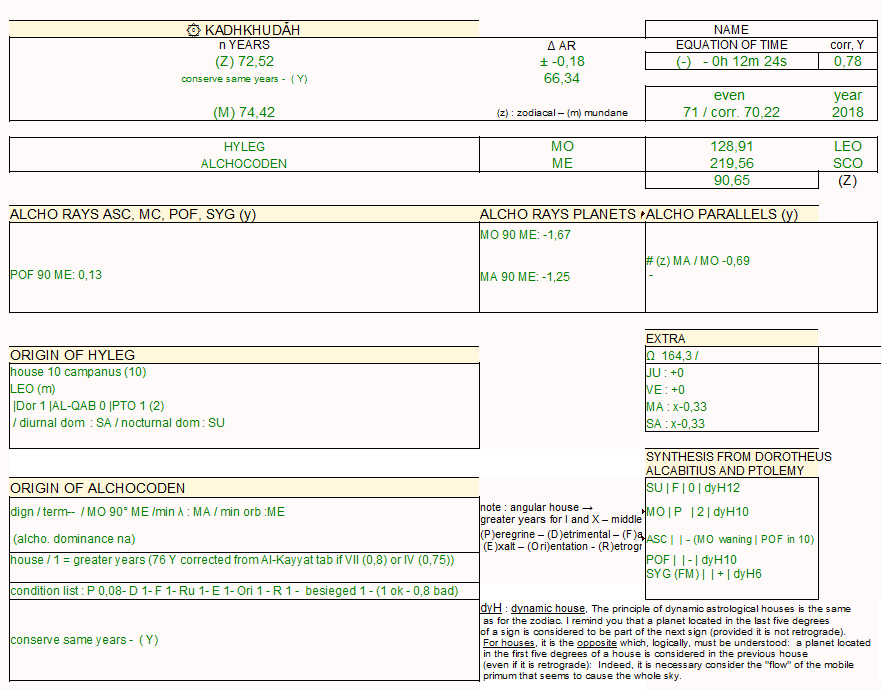
(9 October 1947 – 7 January 2018) French and international popular "yé-yé" singer, daughter of Robert Gall, songwriter, and Cécile (whose father was Paul Berthier, co-founder of "Les Petits Chanteurs à la Croix de Bois"). Married to singer Michel Berger, they had two children. They lost their daughter, Pauline, who was suffering of cystic fibrosis. She announced her retirement in 1997 after Pauline's death and then lived half in France, half in Africa, N'Gor Island, Senegal. As stage director, she created the musical "Résiste" with her companion Buck Dawit, in 2015.
She had breast cancer 10 1993 and recidive in 2015.


Note : conj MO-MA, with both MO and MA peregrine - SU in XII -


ALMUTEN


SPECULUM


RAYS


PARALLELS


ALCHOCODEN


MO hyleg / ME alchocoden -

PRIMARY DIRECTIONS


1)- breast cancer (1993)

(m) #ME conj SA 


mundane chart for 1993


2)- recidive (2015)

(m) #ME conj MA


mundane chart for 2015


3)- exitus (2018)

(m) #MA conj ME


mundane chart for 2018


(z) MA conj SU


zodiacal chart for 2018


mercredi 6 juin 2018

Juana I Castile

Joanna I Castile


(6 November 1479 – 12 April 1555), known historically as Joanna the Mad , was Queen of Castile from 1504, and of Aragon from 1516. Modern Spain evolved from the union of these two crowns. Joanna was married by arrangement to Philip the Handsome , Archduke of the House of Habsburg , on 20 October 1496. Following the deaths of her brother, Don Juan in 1497, her elder sister Isabella in 1498, and her nephew Miguel in 1500, Joanna became the heir presumptive to the crowns of Castile and Aragon. When her mother Queen Isabella I of Castile died in 1504, Joanna became Queen of Castile, while her father, King Ferdinand II of Aragon , proclaimed himself 'Governor and Administrator of Castile'. In 1506 Archduke Philip became King of Castile jure uxoris , initiating the rule of the Habsburgs in Spain, and died that same year. Despite being the ruling Queen of Castile, she had little effect on national policy during her reign as she was declared insane and imprisoned in Tordesillas under the orders of her father, who ruled as regent until his death in 1516, when she inherited his kingdom as well. From 1516, when her son Charles I ruled as king, she was nominally co-monarch but remained imprisoned until her death.


 ALMUTEN score


 ALMUTEN is SA ; observe the conj MA-SA. When Juana became made in 1503, we see a conjunction MC-(MA-SA). And we have also a mundane # VE-SA.

HYLEG score


 HYLEG is SU as SU is < 5° from ASC (dom Campanus = -2.62° I). Therefore, Alchocoden is ME.

Primary direction

At deathn we observe SA conj ME.


and a mirroring direction # SA conj ME


result :


About the madness of Juana, see : 

https://www.persee.fr/doc/crai_0065-0536_1889_num_33_3_69628.


jeudi 29 mars 2018

Copernicus Nicolaus

Copernicus Nicolaus


Nicolaus Copernicus : (19 February 1473 – 24 May 1543) was a Renaissance-era mathematician and astronomer who formulated a model of the universe that placed the Sun rather than the Earth at the center of the universe, likely independently of Aristarchus of Samos, who had formulated such a model some eighteen centuries earlier.

Toward the close of 1542, Copernicus was seized with apoplexy and paralysis, and he died at age 70 on 24 May 1543.


The horoscope, reproduced in Biskup (1973), plate 22, is from Cod. lat. Monac. 27003, a collection of horoscopes of famous people, dated, apparently, to the 1540’s. There is another horoscope for Copernicus in Cod. lat. Monac. 10667 containing the birth date 10 Feb. 1473, 4;38h after noon. Cf. Birkenmajer (1900), 406-12. Most of the positions in the two horoscopes are the same, and the correct date of the horoscope, given by the faster bodies, is definitely 19 Feb. [Swerdlow N.M., Neugebauer, Mathematical Astronomy in Copernicus's De revolutionibus, part 2, p. 454, Springer-Verlag, New-York 1984]

I. Natal chart


ASC VIR, ruler ME (debilitated, PIS). MC TAU, ruler VE. According to Omar and Ibn-Ezra, VE is ALMUTEN (bu VE VIII). According to Lilly, JU is ALMUTEN.

II. Primary directions


A. SA conj ME

This direction is important because of the square radix SA-ME; also because ME being ruler of ASC, is probably hyleg.

1. parameters

2. analysis

3. result
zodiacal

mundane

D --> Z C Regio-Campa EQU orb -0.19.


B. □MA conj ME


1. parameters
The latitude of the square of Mars is obtained by determining the apparent node of MA, according to the method of Morin de Villefranche [cf. Astrologia Gallica, book XXII, sect. II]

'Moreover, in Book 16, Section I, Chapters 6-8, we have reported the opinions of Ptolemy, Cardan, Bianchini. Schöner, Regiomontanus, Origanus, and Algol about the celestial circle in which the aspects of the planets having latitude must be conceived; then, about their correction when they arc referred to the ecliptic; and we rejected those opinions, and set forth our own in Chapter 9. declaring that the aspects of any planet are conceived to be in that great circle, which from its appearance in the caelum deviates least from the path of the planet, and which we have called the circle of aspects;'' and we have demonstrated the method geometrically, by means of which these aspects may be referred by longitude to the ecliptic with their own latitude.' [Astrologia gallica, XXII, trans. J. Holden]

According to Max Duval, Morin's method consists, in the period of days surrounding the birth, of following on the ephemerids, the evolution of the latitude of the planet whose latitude we want to determine an aspect (radix or directional). The MAX of the latitude must be determined and used as the inclination i of this planet (regardless of its orbital inclination). For instance, taking MA as PM, we have :

L MA = 321.71° AQU. lat (MA) = -1.11° on Copernicus's birth day. Search now the Max lat : we find in ephemeris : -1.13° the May 1 1473. (but we take +1.13° because inclination is always taken as positive).
At this time, we compute the nodal distance of actual latitude with :

Dn = Asin ( tan(-1.11) x tan(|max lat|) ) = 279.94° (with |max lat| = 1.13° )

Then, we find the longitude of the node,

L Dn = M(MA) - Dn (or Dn-180°) = 221.77° SCO

We must know if Dn is increasing or decreasing, and being in the quadrants 0°-90° (90°-180°) or opposite sides (resp. Dn or Dn-180))

Then, we compute the Dn' ray : for instance □MA (90°) from L(MA) = 321.71°

Dn' □MA = L(MA = PM) 321.71° + (ray) 90° - (Dn' ray) 221.77° = 189.94°

So, l□MA = atan( tan(|max lat|) x sin (Dn' □MA) ) = -0.19°.

You must read too the translator's comment of J. H. Holden in Astrologia gallica, book XVI, pp. 55-57 which explains the thoughts of Morin de Villefranche.

But we must take into account that the □MA is not zodiacal but mundane: it means that □MA is not equal to 90 ° in zodiaco; it is equal to 83.28 ° in zodiaco and therefore, the Dn 'ray = 183.22 °. So,  l□MA = -0.06 °.

2. analysis

3. result
zodiacal


mundane


D --> Z D Regio-Campa 1/AR orb 0.08.

Conclusion


We must therefore beware that it is not so obvious that it passes from a basis (in zodiaco) to an other basis (in mundo). If one wants to respect the astronomical 'reality', it is nevertheless what one has to do.


vendredi 1 décembre 2017

FREDERICK III

FREDERICK III


Frederick III (21 September 1415 – 19 August 1493), called the Peaceful or the Fat, was Holy Roman Emperor from 1452 until his death, the first emperor of the House of Habsburg. He was the penultimate emperor to be crowned by the Pope, and the last to be crowned in Rome.
Prior to his imperial coronation, he was duke of the Inner Austrian lands of Styria, Carinthia and Carniola from 1424, and also acted as regent over the Duchy of Austria (as Frederick V) from 1439. He was elected and crowned King of Germany (as Frederick IV) in 1440. He was the longest-reigning German monarch when in 1493, after ruling his domains for more than 53 years, he was succeeded by his son Maximilian I.

ex :Vatikan, Biblioteca Apostolica Vaticana, Pal. lat. 1423 Pruckner, Nicolaus; Leowitz, Cyprian
Nativitäten ; Astrologische Urteile.

 ‘Surgery' in the modern sense, as in operations on patients, or amputations, was sometimes carried out successfully. The German emperor, Frederick III (1415-93), had to have his left foot and part of his lower left leg amputated, when he was already in his seventies. The operation took place at Linz on the Danube, on 8 June 1493. An illustration of this exists as a miniature, made by a contemporary Austrian master [Hohenstaufen/Helfenstein 2003, S. 37]. Two physicians were present to advise the emperor, three surgeons held down the emperor, while two more surgeons, master Hans Seylf of Goppingen and Hilarius of Passau, cut off his foot with a saw, so carefully that the emperor hardly felt any pain. After six weeks the emperor’s remaining leg began to heal up, and after a further four weeks the healing process was practically complete. Ironically, Frederick III died later that same year of a stroke brought on by fasting, not due to any adverse effects of the amputation.
[Disability in Medieval Europe: Thinking about Physical Impairment in the ...Irina Metzler,Wellcome Trust Research Fellow in the Department of History Irina Metzler, Routledge, 2006, p. 114]

I)- natal chart


  • ASC GEMINI, ruler ME (VI, SCORPIO)
  • MC AQUARIUS, ruler SA (II, CANCER)
  • opposition MO-VE ; quadrature SU-JU ; sextil MA-ME ; trigone MO-JU
- HYLEG ME
- ANAERETA SA
- ALCOCODEN MA

Morinus gives MA for ALMUTEN.

SU, VE and SA are detrimental.

II)- primary directions


A)- exitus 1493


1)- SA opp ME


direction promissor significator
opp. ME conj. SA opp. ME conj. SA
long 31,59 N E 111,15 S E
lat 3,173 -0,151
AR 28,275 112,852
dec 15,036 21,697
ha 4,979 3,503
OA 11,381 87,357
dom Campa 338,688 44,092
dom Regio 330,113 54,983
Dom Placidus 332,899 61,094
pôle Regio 43,165 31,830
pôle Campa 43,165 31,830
Pôle Placidus 37,296 19,696
DM D|N D |74,705 - N |105,295 D |159,282 - N |20,72
DA pôle D|N D |11,807 - N |24,332 D |35,161 - N |8,189
DA 16,894 25,495
SA D|N D |106,89 N |73,11 D |115,49 N |64,51
D Horiz 32,19 43,79
Htd* 17,816 19,249
DH** -4,193 1,076
TS 313,570 20:54:16,733
lat geo, 47,250
eclip 23,515
birth year 1415
event year 1493
*  temporal hour
(= 1/6e Sad)
** horary distance,
(= mundane positions, see Giuseppe Bezza)


- result


D --> M C Regio-Campa 1/EQU (1.01) orb -0.21.

weighting factor
Z 2,12
M 7,77
X1 0,00
X2 -2,69

This is a weighting attempt, which combines the number of directions and the value of the orbs. On the previous table, we notice that the munding directions exhibit the highest score (7.77).

2)- C MA conj ASC

It is a direct direction. D = 78.052°, with L(z) MAc = 69.974° GEMINI and L(z) ASCd = 136.93° LEO.

We would still have to say on interesting directions, especially ME opp. JU and MO conj JU. These aspects of the RADIX conjunction between JU and VEGA should be compared.


jeudi 21 septembre 2017

COCLITIS CHIROMANTIC

HIERONYMI CARDANI - DE EXEMPLIS CENTUM GENITURARUM


XVIII


  COCLITIS CHIROMANTIS (1467-1504)

1)- introduction

OF ROCCA, Bartholomew, called Cocles. - He was born, as he states, in Bologna on 19 March 1467.
The poor biographical news on D. are mainly contained in his main work, Chyromantie ac physionomie Anastasis, in which he provides some details about his short existence. In D. Proemio's work D. remembers the place and date of birth and later (book III, chapter 251) says he was an illegitimate son (some claim that his mother was a famous midwife of Bologna) who lived always poor (ibid., chapter 183), and as a boy did the barber (ibid., chapter 208). D. was known among his contemporaries, above all with the Latin nickname Cocles, which could mean "without an eye" (but this lack is not documented), both 'grim and crude of character and appearance': this second meaning of the term seems the right one, even on the basis of the testimonies of a few authors behind the Cocles, like Cardano. The name Cocles also printed all his works.
Since he was young, D. has shown a great deal for occult sciences, and at first his focus was on magical practices and the reading of books of necromancy and alchemy. However, soon after the lack of scientific foundation of these disciplines, D. turned to the study of medicine and surgery at the University of Bologna, where he graduated in 1489.
However, D.'s fame is not related to his profession of physician, but to the studies of chiromanzia and physiognomy to which he devoted himself with growing passion, especially after his encounter with the Aristotelian philosopher Alessandro Achillini, who had founded at the Studio bolognese a philosophical-naturalist school. The D. became part of the circle of the disciples of the Achilles, to whom he was deeply adored and with whom he shared the interest in occult sciences. Following the study and practice of these subjects, D. began to perform many vices and predictions with the aim of showing that through the scientific study of human characters it was possible to identify the fate of each one on a concrete basis, astrology operating instead on an abstract field.
Some predictions made by D. and timely occur, made him a big fame among his contemporaries. They began addressing him illustrious figures such as Galeazzo Sforza, brother of the Duke of Pesaro, and soon D. was invited to visit many cities of Romagna, called by their respective rulers, to preach their future. In a letter from Orazio Bicardi di Fano written to Alessandro Bentivoglio on 15 December. 1503 - which is another valuable source for rebuilding D.'s life - is said to have left his country house near Bologna, he first went to Imola, where he predicted the master of that city the end of his rule, then in Faenza, where he had a sad event for Astorgio di Faenza, who died shortly afterwards. From there he went to Rimini, Cesena and Pesaro and met also with the Duke of Urbino Guidubaldo. Also to Giulio Varano, Lord of Camerino, and his sons, he predicted a fateful destiny. But the fame of a prophet of misfortune prompted D. to drive him out of all the courts visited, forcing him soon to return home. In Bologna, for D. he began a period of tranquility, in which he could devote himself to the writing of his text on the physiognomy and coincidence, which began in about 1500 and which saw him engaged until June 28, 1504. On 4th of August, 1504 the work was printed at GA Benedetti in Bologna with the title of Chyromantie ac physionomie Anastasis, cum approbatione magistri A. Achillini. During this period D. also had the task of the Studio di Bologna to teach grammar, academic year 1503-04, to four "poor shameful" cities, without any remuneration, according to custom.
Twenty days after the publication of his work, on the 24th of September, 1504, D. died, in Bologna, assassinated almost certainly by the hand of an Antonio Caponi.


2) natal chart


- FOMALHAUT dom 106°07' Campanus ; ALGOL dom 188°09'
  • ASC SCORPIO, ruler MA (II, CAPRI)
  • MC VIRGO, ruler ME (IV, PISCES) - FOMALHAUT opp MC
  • MO conj ALGOL, opp ASC, conj JU
- HYLEG : ASC
- ALCOCODEN : MA
- ANAERETE : SA

Morinus gives MA for ALMUTEN. We have in domitude : MA // SA.
3 planets are detrimental : ME (+) EXIL and opp MC (IV, cadent) - VE - SA

It is also very interesting to see the antiscion.


Due to the accidental disposition of the planets, one notices a rather surprising configuration : ME, VE and SU, SA are covered by their antiscion mirroring images :

PARALLELES. There are two kinds of parallels : zodiacal and mundane. Zodiacal parallels are circles équidistant from the equator, namely, the beginning of ARIES and LIBRA, and consequently any two points of the zodiac haying equal déclination, whether of the same or the opposite kind are in zodiacal parallel with each other. Thus, a star in 2° of another in 28° degrees of CAPRI, anotber. in 2° of GEMINI and another in 28° of CANCER, would all be in zodiacal parallel to each other, because they would all have the same declination in the number of degrees and minutes, viz. 20° 38'. The two first are called antiscions, because they have the same declination in number and name, viz. 20° 38' south declination ; the others are also antiscions in the same way, as having 20° 38' north declination, but the two former are called contra antiscions to the two latter, because, although their declination is the same in number, it is different in name, one being north and the other south declination. Those having north declination are called commanding, and the Southern, obeying : because the north being nearer our zenith must be most powerful. An antiscion is held by some to have the effect ot a * or v and a contra antiscion that of a □ or o-o, but Placidus makes no such distinction. [A Complete Dictionary of Astrology, in which every technical ... term ... Par James WILSON, London, 1819]

Note particularly the superposition  of ME and VE.

3)- primary directions

a)- SU opp MC


D = ts-ARsu = -177.79 (or 2.20° IC - recall : the birth hour is approximate for the axis directions). It should be known that this type of direction: SU opp MC (conj IC) is often encountered during the brutal deaths.

b)- SA conj ME


results :


overall results - primary and mundane Rp

%
1 C Regio Campa 1 0,1
0 D Placidus 1 0
0 D Regio Campa
0 overall diff,
1 C Placidus
0,1 0,1
2


0

1503,75

0
fictitious C SU opp. MC Dir % 0,1
0 D – AR 0 0 0
0 AO 0 0
0 Gold Regio 0 0
0 Gold Placid 0 0
0 Symb 0 0
0


We find 2 primary directions and none fictitious ; so the overall difference is 0.1 x2.

c)- #MO conj MA (in zodiaco)


- result


overall results - primary and mundane Rp

%
1 C Regio Campa 2 0,3
1 D Placidus 2 0,2
1 D Regio Campa
0,2 overall diff,
1 C Placidus
0,3 -0,3
4


0,2

no ray

0,2
fictitious C MA # MO Dir % 0,3
0 D – AR 0 0,6 -0,2
0 AO 0 0
0 Gold Regio 0 0
0 Gold Placid 0 0
2 Symb 2 0,2
2


We have 2 Placidus and Regio directions ; 2 symbolic directions as fictitious.