Affichage des articles dont le libellé est birth year. Afficher tous les articles

vendredi 7 septembre 2018

Henry V of Englang

Henry V of England


Henry V (August/September 1386/7 – 31 August 1422), also called Henry of Monmouth, was King of England from 1413 until his early death in 1422. He was the second English monarch of the House of Lancaster. Despite his short reign, Henry's outstanding military successes in the Hundred Years' War against France, most notably in his famous victory at the Battle of Agincourt in 1415, made England one of the foremost military powers in Europe. Immortalised in the plays of Shakespeare, Henry is known and celebrated as one of the great warrior kings of medieval England.

The uncertainty about Henry’s date of birth stems from the different ways of expressing it chosen by writers of the time. These are as follows: (a) a clear date, e.g. 16 September 1386 (John Rylands University of Manchester Library, French Ms 54). (b) Henry is said to have been in his twenty-sixth year (i.e. he was twenty-five years old) when he was crowned in April 1413. (c) Henry’s death on 31 August 1422 occurred in a particular year of his life (e.g. in the thirty-sixth year of his age (i.e. he was thirty-five years old). First English Life of King Henry the Fifth, ed. C.L. Kingsford (Oxford, 1911), p. 182). If he was born on 9 August, this gives the year as 1387, if on 16 September (the feast of St Edith, as some contemporaries pointed out), Henry must have been born in 1386. See C.L. Kingsford, ‘The early biographies of Henry V’, FAIR, 25 (1910), 62. (d) Writing in 1896, J.H. Wylie chose August 1386 (History of England under Henry the Fourth (4 vols, London, 1884 98), iii, 323-4). W.T. Waugh, author with Wylie of The reign of Henry the Fifth (3 vols, Cambridge, 1914-29, iii, 427), claimed 16 September 1387 as ‘correct’. The Times used to favor 16 September; the Independent recorded both the August and September dates (for 1387). [Henry V, Christopher Allmand, Early years, note 2]

Our choice is 16 September 1387.


See Oxford, Bodleian Library, Ashmole Ms 393, fos 109-11; Ms 192, pt iii, fos 26-36; and M. Carey, ‘Astrology and divination in later medieval England’ (Univ. of Oxford D.Phil, thesis, 1984), p. 19.
See also : Courting Disaster, Carey, p. 253.

almutens


speculum


recall : DOM is the planet nearest from MC. MO and SA are unfortunate.

rays


- worst ray : MO square Sa
- best ray : MA conj JU

parallels


hyleg - alchocoden


notes :
- MO square SA = -25 (lesser years of MO) because of the affliction of the two planets.
- there is no ray between SA and SU, but three dignities (term, tri and Exn).

primary directions


- square SU (z) conj SA


Zodiacal converse direction of ray square SU.


lundi 18 septembre 2017

CORTI MATTEO

HIERONYMI CARDANI - DE EXEMPLIS CENTUM GENITURARUM


XIV

  CORTI MATTEO (1475-1542)

1)- introduction

CORTI (Curti, Curtius, Curte, Court), Matteo. - He was born in Pavia in 1475 by noble but not rich family; so he had to deal with many problems to keep up to his studies. He soon revealed an exceptional disposition for the study of medicine; He graduated in that discipline in Pavia in 1497 and was immediately called to teach at that university from the same year in 1497. He read Greek doctors and scholastic philosophers (since 1499 he had been reading ordinary logic for many years); he remained in Pavia - except for some untraceable absence - until 1512, when he was also among the promoters of the laureates. He became famous in his medical doctrine, he was called to Pisa, where he also taught his brother Francesco, a well-known juristic consultant; here began teaching from November 1515, with the prestigious wage of 400 ducats annually, until 1524, when he gave the insistence of the Provvidenza to the Studio of Padua, whose offers had refused seven years before preferring to stay in Pisa. In that year Brother Francis, French-speaking, lost all his possessions and was also imprisoned following the Battle of Pavia; before his death in 1531, he obtained, by virtue of C., the restitution of the goods and of the chair. Meanwhile, in Padua, C. continued his medical teaching (in recent years also anatomical) for seven years, with a salary of 600 ducats, which in 1529 rose to 800. In 1530 he began to lecture on the Anatomy of Mondino de ' Liuzzi, which will then be collected and reworked later in his greatest work. But the following year, invited by Pope Clement VII to Rome, he left office to Francesco Frigimelica. He thus became a Pope's personal doctor with the salary of a thousand golden ducats and the usufruct of a house in the Ponte district, inhabited first by the bishop of Terracina Giovanni Copis and then by the bishop of Caserta, Giovan Battista Bonciani, whose heirs they cried with C. a lite, a source for him with no hesitation. He was actively involved in the literary and scientific discussions promoted by the Pope: for example, a lecture by the German scientist Alberto Widmannstadt on the Copernicus system, which was attended by C. in 1533. There was no criticism of his doctor's work by opponents such as Andrea Turini ; in fact, its poor consistency was known: a strong supporter of the Greek or Galenic method in the treatment of pleurisy, when he suffered from such illness, allowed his caring physicians to use the first blatant Arab method. 
 In Mundini Anatomen explicatio, 1550
 
As a Pope's personal physician and dietician, he had to accompany him on his journeys; when he went to Marseille (1533) for the wedding of the great-granddaughter Caterina de 'Medici with Enrico, son of the King of France Francis I, C. advised him not to interrupt his care based on the waters of the Tiber, a certain amount with himself. But the pope proved inadmissible to C.'s medical prescriptions, on the contrary, it seemed to him that he had used the habit of dinning with excessive abundance. When he died, in September of the following year, serious accusations were made against the work of C .; more than all by Cardan, who was considered his pupil and was so considerate of having an honor to argue with him (he is grateful to have indicated him as his worthy successor to the Bolognese chair); Well, it was Cardan himself to accuse him, in his Theonoston, of having killed the pope with wrong medication, not having prescribed it, for example, a better cooking of food.
Despite the defenses of physicians such as Andrea Bacci, C.'s reputation had to be hit hard, if he decided to leave Rome shortly after the Pope's death, to go first to Pavia and then to Bologna (from 1538) where he was a reader of medicine at the university until year 1541, in place of Francesco Bergomas, with the salary of 1,200 shields. Cosimo de 'Medici called him as a personal physician and entrusted him, at the same time, from 1544 to the chair of theoretical medicine at the University of Pisa. His twenty-year teaching in this city acquired a solid fame, which attracted him to listen to scholars and students from various cities. No one knows of his marriage, except that he had a son named Raffaele, whom the pope granted some ecclesiastical anniversaries and died in 1545. In Pisa, the C died about 1564, probably because of a gastric disorder, and was buried in monumental campus with a praiseworthy praise dictated by Cosimo I. There are some uncertainties about the actual date of death that someone anticipates in 1545 or 1542.


2) the geniture


the theme of Cardano is ambiguous. Indeed, it specifies 4h15 a meridie whereas the natal chart is obviously constructed post meridie, for about 5:15 PM...
There is also a doubt about the death of Curtius : 1542 or 1564... But there is a note by Nancy Siraisi :

On Corti (1475-1544), see Vivian Nutton, "'Qui magni Galeni doctrinam in re medica primus revocavit': Matteo Corti und der Galenismus im medizinischen Unterricht der Renaissance," in Der Humanismus und die oberen Facultaten, ed. Gundolf Keil (Weinheim, 1987), pp. 173-84, and A. De Ferrari, "Corti (Curti, Curzio, de Curte, de Corte), Matteo," Dizionario biografico degliitaliani 29 (Rome, 1983): 795-97. I give the death date as corrected by Nutton.

Conversely, Cardano was very respectful of physicians of European fame — especially perhaps those from outside Italy — whom he knew via their writings. In the same letter, he ranked leading contemporaries. Leonhart Fuchs, Janus Cornarius, and Antonio Musa Brasavola were all undoubtedly
distinguished, on the basis of their numerous and widely read works. He was considerably less appreciative of Matteo Corti, one of the most famous Italian physicians of his generation, whom "I would not have dared to put in the same category if I had not heard him lecture [nisi audisse non auderem his adnumerare]. The judgment on Corti, an enthusiastic proponent of Renaissance Galenism, undoubtedly had personal as well as scientific elements. Corti, who came from Pavia, had
been Cardano's teacher at Padua. He thought well enough of the young Cardano to recommend him for a professorship of medicine at the University of Pisa, even though the two had quarreled over a debt. When Cardano looked back on the episode at the end of his life, he took pride in remembering that it had never caused him to deny Corti's erudition ("non eruditioni eius invidi"). In a horoscope for Corti published in 1547 (after the latter's death), Cardano characterized him as a famous medical practitioner and professor of medicine, with great knowledge of things, but envious and full of suspicion. He also expressed the opinion that Corti's mistaken dietary recommendations had hastened the death of Pope Clement VII. Envy and suspicion seem to have been the hallmarks of this professional relationship, perhaps on both sides but certainly on Cardano's. [The Clock and the Mirror, Girolamo Cardano and Renaissance Medicine, Nancy Siraisi, pp. 31-32, Princeton University Press, 1997]


  •  ASC LEO (but (I) recovers VIRGO) ; so ruler SU (DSC) and ME (VI).
  • MC TAURUS (ruler VE, ARIES in (VIII))
  • JU // MO
  • VE VIII
 Morinus gives SA for ALMUTEN. Note that VE, JU are detrimental.

- HYLEG : not SU none MO ; 
- ANAERETES : SA, VE (+)
- ALCOCODEN : ME

3)- primary directions


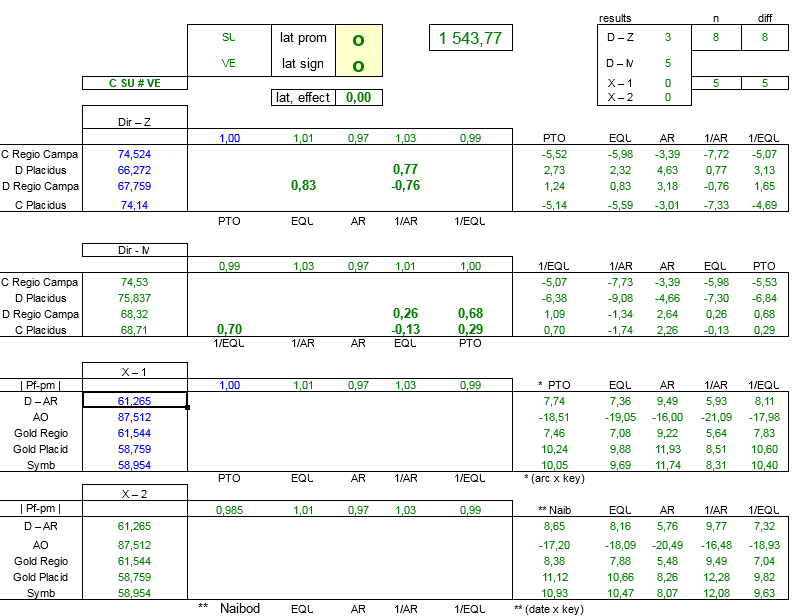
a)- SU # VE


 We find a counter-parallel SU # VE (1545).

 D Placidus (0.4). None fictitious.

b)- C VE conj ME


 C Placidus (0.4).


mardi 5 septembre 2017

CARDANO Fazio

HIERONYMI CARDANI - DE EXEMPLIS CENTUM GENITURARUM


IV

CARDANO Fazio

1)- introduction


The year of birth of Fazio Cardano is incertain: 1444 or 1445? We are therefore placed in a situation where we must make a bet on the validity of the rules of astrology. We will therefore consider the two occurrences and establish a diagnosis of presumption. In any case, Jérôme Cardan gave the theme of his father in De exemplis Centum Geniturarum [in opera omnia, vol. 5, p. 460] and in Hieronymi Cardani medici Mediolalnensis, Libelli quinque [p. 106] : july 25, 1445 (Gregorian) at 8h40 AM (i.e. 3h20).

My father Fazio was a jurisconsult. My grandfather was Antonio, my great-grandfather another Fazio, my grcat-great-grandfather, Aldo. The first Fazio, my great-grandfather, had three sons: Giovanni, Aldo II and Antonio who became my grandfather. The sons of Antonio were Got-tardo, Paolo, a jurisconsult and prelate, Fazio, my father, and an illegitimate son named Paolo. Now there are alive, from the same family, almost thirty kinsmen. Whether, however, the family of the Cardani is a line in itself, or whether, as certain people think, it is a branch of the Castiglioni, surely it has been both noble and ancient. From the year 1189 a Milonc Cardano was prefect of Milan for seven years and eight months by the ecclesiastical as well as the civil calendar. And he presided not only at civil suits, but even, like other Chiefs of State, at criminal trials; he had charge, also, of cases in other cities which were under Milanese jurisdiction; and cases throughout the whole region. Among these cities was Como. Milone had secured this high post of honor through the Archbishop Crivelli when the latter had been hurriedly advanced to the Pontificate as Pope Urban III.

There are those who would like to have it that Francesco Cardano, leader of the military troop of Matteo Visconti, belongs to our branch of the family. If we arc a branch of the Castiglioni, however, we are still more illustrious because of Pope Celestino IV who sprang from this same stock.

All our forebears have, moreover, been longevous. The sons of the first Fazio lived ninety-four, eighty-eight and eighty-six years. The two sons of Giovanni, my great-uncle, were Antonio, who lived eighty-eight years, and Angiolo who lived ninety-six years. As a boy I saw this decrepit old man. Giacomo, an only son of the second Aldo, passed seventy-two years. Gottardo, my paternal uncle, lived eighty-four years, and him also I saw. My father lived eighty years. That cousin Angiolo, the one who reached his ninety-sixth year, begot sons—infants feeble as if with their father’s senility—even when he himself was in his eightieth year, and after his eightieth year he recovered his sight. The eldest of these sons has lived to be seventy, and I hear that some of his children became giants; indeed, I saw some of them long ago.

There were, besides, from the family of the Micheri (my mother Chiara’s family), my grandfather Giacomo, who lived seventy-five years and his brother Angiolo who was in his eighty-fifth year when I was a little boy. He himself told me so. [excerpt from De Vita propria liber (The Book of my life), translates by Jean Staner 1929.]


2)- natal chart


The natal chart is characterized by a close conjunction VE-SA (I), ASC CANCER (ruler MO VI); SU I. But I do not see how this aspect of the sky could be compatible with a life as long as that of Fazio.The primary directions seem to indicate a death nearly 30 years... If we consider the year 1444, the aspect of the natal chart changes completely.
Let us therefore assume that Fazio was born in 1444, which seems accredited by many documents (but Cardano compute the geniture for 1445 ...).

  •  ASC CANCER, ruler MO (I) and SU (I).
  • MC PISCES, ruler JU (CANCER), conj. SA
  • ALMUTEN (Morinus) : MO
 So, MO is ALCHOCODEN and ALMUTEN ; SU is HYLEG. ANAERETE is MA.

We have two major dates for Fazio, including that of his meeting with his wife, Girolamo's mother. It was about 1498: Fazio was then 53 years old. The other date is that of his death: 1524.

3) primary directions

A)- 1498

 We have to compute the parallel rapt MO || JU which occurs around 52 years. This is the very type of direction that occurs when forming a couple. This was the case for Fazio, since he lived in concubinage with Chiara Micheri, future mother of Girolamo. Morinus finds Rp MO || VE at 53.8 ° (PTO), corresponding to 1498.


Here we see all the Rp between MO and VE for the three types of domitude. We have computed this RP according to the MO motion (2.201° for 52 years) and to the latitude of MO.
Note that we have another way of calculating rapt-parallel: mean that the designer of Morinus seems to have used, by reference to the algorithms of Makranski: it is to consider VE as significator and to direct ASC as promissor. And we find therefore :


C Regio Campa 47,116
D Placidus 53,228
D Regio Campa 53,228
C Placidus 45,06

Recall : Morinus 53.8° for Placidus. We find 56.46° with Campa and 53.19 with Regio (PTO).

B)- 1524


At the time of the death of Fazio, two world divisions are in orb: C MA conj MO and C VE conj. SA.

1)- compute MA conj MO


 a) - parameters


b)- results


As you can see, we have only one direction that is compatible with the date. From  mundane regio-Campa 76.98°. And the date is actually 1523.73. However, I must point out that these results are not complete. The following table supplements these incomplete data, not so much because of the method employed as for the formulation of the orb and the keys employed.

c) reflections about results 


As we see the orb of the key AR is tightened significantly [0.99-1.01]. If we practice, by way of example, the analysis of this direction without latitude, we obtain the following table, quite different:


  The absence of latitude leads to a shift of the aspects below the key of Ptolemy.

 2)-#MO conj MA


The zodiacal directions are marked by a converse conjunction of #MO to MA and especially rarely, by a conjunction of two #, due to the Moon's proper motion: #MO conj #SA.
Let's see the first direction:

- parameters 


 - results

 We observe two arcs of direction in mundane Placidus.

3)- compute #MO conj #SA


Take MO = 12°53'17' SAGIT and SA = 15°29'07" SAGIT ; sum L MO and proper motion : 3.261. You will havean arc of D = 0.6° between MO and SA. So, it is a true secondary direction by proper motion of MO.

mercredi 24 mai 2017

Cardano's twelve horoscopes [12]

CARDANO'S TWELVE HOROSCOPES


GENITURA XII


Hieronymi Cardani (1501-1576)


12. Érasme de Rotterdam (Desiderius Erasmus Roterodamus), né dans la nuit du 27 au 28 octobre, en 1467 (ou en 1466) à Rotterdam, comté de Hollande, et mort le 12 juillet 1536 à Bâle.

a)- le problème de l'année de naissance

FIGURE I : D. Erasmus Roterod.


Nous devons d'abord faire le choix de l'année de naissance d'Erasme, car si le millésime est correct (28 octobre), l'année ne l'est pas. On trouve déjà des notes intéressantes p. 7-8 dans : Preserved Smith, Erasmus: A Study of His Life, Ideals and Place in History ainsi que dans l'appendice A (the year of Erasmus's birth, pp. 445-446) qui tendent à privilégier nettement l'année 1466. Dans l'article de Gleason (in Renaissance quaterly, 1979), il reste vraiment peu de doute quant à cette hypothèse sur 1466. Quant à l'article de Harry Vredeveld, c'est tout simplement une somme d'érudition sur le sujet qui, là encore, met en exergue l'année 1466.
The date of John Colet's birth is of interest not only for his biography but for his own biography but for that of his friend Erasmus. In the long letter of June 13, 1521 in which he describes at length the life and career of Colet, Erasmus mentions that when the two men first met Colet was 'about thirty years old, two or three months younger than I.' Erasmus celebrated his birthday on the Feast of Sts. Simon and Jude (October 28), but thanks largely to his own mystifications on the subject there is no agreement among his biographers as to the year of his birth. [...] The evidence to be considered here tends to confirm the date 1466.

The careful study by A. C. F. Koch on The Year of Erasmus’ Birth devotes a section to ‘The Age of Erasmus Compared with That of Colet.’4 Though Erasmus’ statement quoted above seems to offer a promising start, Koch argues that there is no entirely satisfactory evidence for the year of Colet’s birth. [...] From the statement by Erasmus, who celebrated his birthday on October 28, that Colet was his junior by two or three months, it follows that Colet was born in all likelihood in December or January. However the latest of the inquisitions, from London itself, still declares him thirty-eight and more in mid-January. Colet’s birth may therefore be dated the latter half of January 1467. Now that Colet’s birthdate can be fixed with certainty it is clear that, to the extent Erasmus’ birthdate is inferable from his, the Dutch humanist must have been born on October 28, 1466, for no other October 28 is consistent with the data here considered.
bibliography :
- Preserved Smith, Erasmus: A Study of His Life, Ideals and Place in History (New York, 1923), Appendix I 'The Year of Erasmus's Birth,' pp. 445-446 ;
- The Birth Dates of John Colet and Erasmus of Rotterdam: Fresh Documentary Evidence, John B. Gleason Renaissance Quarterly Vol. 32, No. 1 (Spring, 1979), pp. 73-76 ;
- The Ages of Erasmus and the Year of His Birth, Harry Vredeveld Renaissance Quarterly Vol. 46, No. 4 (Winter, 1993), pp. 754-809

b)- le choix du thème

[Cardano, XII geniturarum, 552, 3h45 ante ortum solis - Gauricus, 66r, 16h30pm - Garcaeus, 144, même heure - Gadsbury, 82, idem, d'après Origanus, p. 216]

Nous allons d'abord essayer de dresser le thème d'Erasme pour l'année 1467, selon la leçon de Cardano.
FIGURE II : geniture 1467

En 1467, le thème permet de relever en domitudes radix les éléments suivants :
  • // Venus-Saturne ;
  • // Mars sur Soleil, Lune ;
 C'est le thème qui peut être associé à un individu promis à des infortunes telles qu'elles paraissent n'être que peu compatibles avec une grande longévité... Les directions primaires in mundo montrent en effet un train d'arcs vers l'âge de 23 ans assez impressionnant. On relève par ailleurs MO cazimi. Voyons la disposition du thème pour l'année 1466 :

FIGURE III : geniture 1466

La figure a été dressée pour 4h40, soit une rect. de 10 min par rapport à Gauricus et Garcaeus. Nous retenons Mars angulaire à l'AS, Lune au MC ; parallèle in mundo entre le Soleil et Saturne.

disposition des étoiles fixes :
  • Arcturus et Spica en conj. apparente avec l'AS ;

    - Spica : Unbounded good fortune, happiness, ecclesiastical preferment, unexpected honor or advancement beyond native's hopes or capacity. [Robson, p.211.]
    - Arcturus : Good fortune, with many cares and anxieties through own folly. [Robson, p.139.]
  • Unukalhai  (α Serpens) en conj. avec le Soleil ; Many quarrels and disappointments, unfortunate life, seriously affected by death of family or friends. [Robson, p.213.]
  • Alcyone en conj. avec Jupiter ;

    Deceit, hypocrisy, legal and ecclesiastical troubles, loss through relatives, banishment or imprisonment. [Robson, p183].
domitudes Campanus :
  • Arcturus 343°53'
  • Spica 0° 02'
  • Unukalhai 8°52'
  • Alcyone 212°08'
FIGURE IV : fixed stars in mundo

On remarque que l'axe Mars, AS, Spica domine la scène thématique. Erasme perd ses parents très tôt ; c'est le fils illégitime d'un prêtre. Il est ordonné prêtre en 1492. Il fait la connaissance de John Collet en 1499 [qui a posteriori permettra de retrouver la date de naissance probable d'Erasme]. Il devient docteur en théologie, à Turin, vers 1508. L’Éloge de la Folie est publié en 1511. Il devient conseiller de Charles Quint à partir de 1517. Le Collegium Trilingue, inspiré par Érasme, fut inauguré en septembre 1518 à Louvain. Entre 1521 et 1529, il séjourne à Bâle, où il publie la majeure partie de son œuvre (éditions et commentaires de presque tous les Pères de l’Église). En 1522, c'est la première édition des Colloques et la publication du De conscribendis epistolis. En 1529, la ville de Bâle étant entièrement acquise à la Réforme, il préfère s’installer à Fribourg-en-Brisgau, où il écrit son dernier grand ouvrage : L’Ecclésiaste. Il meurt le 12 juillet 1536 à Bâle.

Until his death in Basel in July 1536, Erasmus would be forced, for a variety of reasons, to lead a wandering life. His enemies, first among them Luther after their break in 1524–25, called him an errans mus, a ‘roving rat’. He stayed in Louvain, then in Venice and Rome; spent longer periods in Basel, Freiburg-im-Breisgau and, again, in Paris, Orléans and Lyon.
[Erasmus, Jean-Claude Margolin, Prospects : the quarterly review of comparative education (Paris, UNESCO: International Bureau of Education), vol. XXIII, no. 1/2, 1993, p. 333–352]

- En 1492, on remarque en DP in mundo, une conjonction entre le Soleil et Unukalhai, ainsi qu'un parallèle entre Jupiter et Arcturus. Il y a aussi un rapt-parallel entre Mars et Mercure ;
- En 1508, parallèle Jupiter - Mars et conjonction Soleil-Mars. Egalement, parallèle Mars - Alcyone (à 2° près).
- En 1511 : opposition Jupiter, As et Spica - rapt-parallel Mars-Lune -
- En 1517 : opposition Jupiter - Mars -Venus conj Soleil (1515)

Notons que la direction majeure, celle correspondant à la publication de l'Eloge de la Folie, met en jeu l'axe AS, Mars, Spica, relativement à Jupiter.

FIGURE V : directions in mundo


Lors du décès, on trouve deux directions D Saturne opp. Lune et D Mars // Lune (avec un rapt-parallel entre Mars et Saturne). On retient une conjonction entre Unukalhai et Vénus ainsi qu'une opposition entre Jupiter et Arcturus.

directions zodiacales :

FIGURE VI : directions in zodiaco


L'étude des directions dans le zodiaque est surtout utile pour repérer les directions du soleil et de l'AS. Les directions mondiales semblent utiles quand on prend la mesure des points marquants tels que la Lune ou Vénus, c'est-à-dire de points ayant une certaine latitude. Il me semble logique d'étudier ces directions dans le sens apparent où nous voyons la voûte céleste entraînée par la rotation terrestre ; ce qui est à la base du concept de primum mobile.
Par conséquent, avec Morinus (v. 8.1.0), j'utilise les directions in mundo direct et in zodiaco convers.

*
**

Ici, on cherche la direction zodiacale converse : # Saturne conjonction Soleil. A noter que le logiciel Morinus détermine les parallèles zodiacaux avec latitude. Je rappelle qu'un aspect parallèle porte le symbole // et un contre-parallèle le symbole #.

 1) - relevé des paramètres indispensables :

    longitude du Soleil : 213°34'02" ;
    latitude géographique (latgeo) (Rotterdam) : 51°55'N
    écliptique en 1466 : 23°30'29"
    longitude de # Saturne : 170°25'28"
    TS natal : 7h 40min 11s (soit 115°02'48")

2)- calculs relatifs au point fixe : (# Saturne)

    AR f = 171,20°
    dec f = 3,79°
    h = (TS-AR f) = 115,04°- 171,2° = -56,156°
    domitude Campanus = 334,523°
    pm =  270°-334,523° = 64,523° (pour maison diurne 270°, pour maison nocturne 90° de domitude ; pm doit être toujours < 90°)
    pôle du cercle de position de ce point : sin p = sin latgeo x sin pm => p = 45,282°
    angle A (angle du méridien supérieur correspondant à l'horizon de pôle p, avec le méridien supérieur natal)
    cos A = tan p/tan latgeo => A = 63,022° (toujours < 90°)
    point fixe en maison XII (# Saturne)

3)- calculs relatifs au point mobile : (Soleil)

    AR m = 221,09°
    dec m = -15,96°
    angle B (semi-arc diurne du point mobile correspondant à un horizon de pôle p, qui est le cercle de position du point fixe ; B est un semi-arc fixe dans tous les cas)
    cos B = - tan p x tan dec m => B = 73,26° (> 90° si signe p = signe dec m ; < 90° si signes #)

4)- calcul de l'arc de direction :

La domitude du point fixe étant en secteur oriental diurne (i.e. maisons X, XI, XII) en l'occurrence # Saturne (maison XII), on a :

D = (AR m - TS) + A - B => D = 70,539° (le logiciel Morinus donne 70,524° d'arc).

Si nous prenons la direction inverse, i.e. celle considérée comme directe, on trouve :


 Mais la domitude fixe étant en secteur oriental nocturne (i.e. maisons I, II, III), en l'occurrence le Soleil (maison I), on a :

D = (Ar m - TS) - A - B  => D = 71.607° (Morinus donne 71.607°).