ZADKIEL I
R.J. Morrison (1795-1874) was better-known as Zadkiel(1), the leading astrologer in mid-Victorian England and editor of Zadkiel's Almanac. Started in 1832, this annual publication catered, unlike the long-standing Moore's Almanac, to a metropolitan audience of largely middle-class readers. Zadkiel was a retired naval officer when he took up astrology and astronomy and began to publish his annual, Zadkiel's Almanac. This publication followed the lead of The Prophetic Messenger and adopted its sensationalistic and Romantic style to the same if not more success.
Zadkiel (1849), The Grammar of Astrology, London.
Zadkiel (1882), Lilly's Astrology, London: George Bell and Sons.
bibliography
Curry, Patrick, Prophecy and Power: Astrology in Early Modern England (Princeton, N. J.: Princeton University Press, 1989)
Curry Patrick, A confusion of prophets : Victorian and Edwardian astrology, London, 1992, cap. iii, pp. Zadkiel, Astrology on trial
Curry, Patrick, ‘Astrology on Trial, and its Historians: Reflections on the Historiography of “Superstition”’, Culture and Cosmos, Vol. 4 no 2, Autumn/Winter 2000, pp. 47-56.
Alfred John Pearce, the Text-Book of Astrology, cap. xxxviii, pp 237-240, London, 1st ed 1911
(1) Zadkiel I ; A.J. Pearce was the Zadkiel II
ZADKIEL'S PROPHECY ON LORD PALMERSTON.—
In Zadkiel's Almanack for the year 1865 (p. 48), there occurs the following paragraph —
" The Nativity of Lord Palmerston, born 27th October, 1784.—In the month of April, about the seventh day, the evil Saturn will transit the place of the Sun by retrograde motion, which is very threatening for health, and may well denote his resignation or his overthrow. But we find some serious trouble or suffering as early as in December, 1864; and then we find the great eclipse of the Sun on the 19th of October, close on the place of the Sun at his birth. This, if he overcome the earlier evil influence this year, will I expect put an end to his power and endanger his life."
This horoscope and Lord Palmerston's lamented death, the day before the eclipse, present a remarkable coincidence. [quoted in Notes and Queries, November 1865, s3-viii, p. 389]

source : Curry Patrick, A confusion... p. 61
Richard James Morrison was bom at 9.58 a.m. on 15 June in Edmonton, North London. His family background was genteel, with a tradition of naval and colonial service. He joined the Royal Navy at the age of eleven, and in the next nine years saw action in the Mediterranean against the French. After serving aboard the cruiser Spartan, he was decorated for bravery and promoted to lieutenant commander in 1815. Two years later, he retired on half-pay and served in the coastguard. In 1827, he married Sarah Mary Paul, the daughter of an Anglo-Irish baronet, in Waterford; they had nine children before she died in 1849. He married again soon after her death and yet again after the death of his second wife. [...] The ruling passion of Morrison’s life, however, was astrology. By 1824, he was a member of Raphael’s occult group the Mercurii, but in 183! he became Raphael’s commercial competitor. Inspired by the success of the latter’s Prophetic Messenger, Morrison issued his own version, The Herald of Astrology, for the following year. On its title-page, he makes his first appearance as ‘Zadkiel, Tao Tse‘, followed, startlingly, to modern eyes, by a swastika. In so doing, Morrison had two intentions. One was to proclaim his existence as an astrologer while protecting his personal social standing — an ambition in which he was to be not entirely successful. The other was to display, to those in the know, his occult credentials: Zadkiel is the Cabbalistic name of the angel of Jupiter, the planet of wisdom; Tao Tse refers to the semi-historical founder of Taoism in fourth-century B.C. China; and the swastika was a metaphysical symbol in several cultures long before the Nazis adopted it.
[Curry, A confusion... pp. 61-62]
It seems that the natal hour was quoted in Pearce's book 'Text-Book of astrology', p.99. Actually, we find this hour p. 105 of the second edition of 'Text-Book'.
---------------------------------
ZADKIEL I
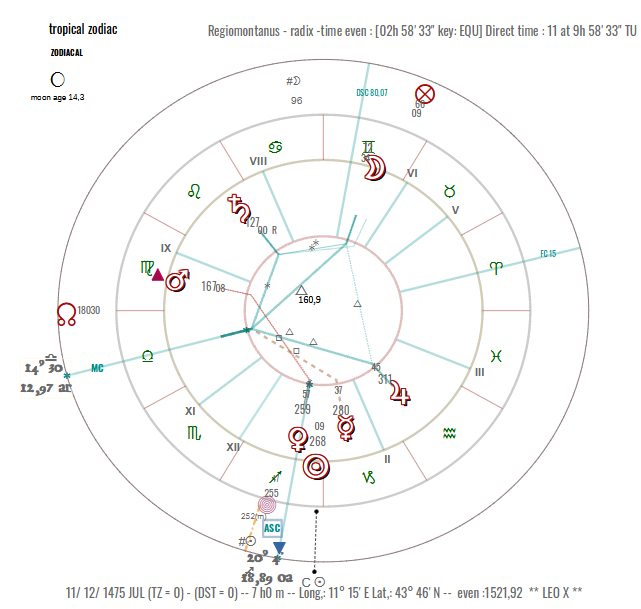
15 Jun 1795 GREG CAL
monday GREG
| lat 51° 39' 59" | N 0°6' W
0
---------------------------------
natal (bt) 13 h 30 min
raas-rams :23h 59' 59"
reckoned bt Lat --> lmt 9 h 45 min
tu 9h 45' 0"
tsn 3h 18' 53"
---------------------------------
timezone : 0
DST : 0 (-)
Equation of time -0h 0' 0"
ΔT 0h 0' 16"
---------------------------------

THEME
SU is Fa with a [10] score - house rgo 10
MO is P with a [-2] score - house rgo 10
ME is te - T - Fa with a [9] score - house rgo 11
VE is Ru with a [2] score - house rgo 10
JU is P with a [-21] score - house rgo 10
MA is T cb with a [8] score - house rgo 5
SA is T with a [12] score - house rgo 10
no point in critical house
points to specially watch for the social destiny: SU MO in house X - SU besieged, possible legal problems
we see below the list of aspects :
---------------------------------------
SU[1,01 Or 0]MA MO[4,13 Or 0]SA VE[-2,58 Occ 120]JU
---------------------------------------
The traditional almuten (Omar, Ibn Ezra) is ME
we see below the list of dignities for ME :
---------------------------------------
[ term 3 tri 1 rul 2 exn 1 fac 3 ]
[ su 1 mo 3 asc 4 syg 0 pof 0 ]
---------------------------------------
Note 1 : the ‘almuten figuris’ is the lord of the chart, but its determination obeys somewhat different rules according to the schools. The tradition is based above all on the zodiacal dignities. (see p,e, Alcabitius, Introduction, 59-61, 117 and Avenezra, Nativites, 101) – almuten = al-mu’tazz (arabic term)
[7] As for the governor which is the <planet> predominating (al-mubtazz) over the birth from which one indicates the conditions of the native after the haylāğ and the kadhudāh,n it is the planet having the most leadership in the ascendant, the position<s> of the two luminaries, the position of the Lot of Fortune and the position of the degree of the conjunction or opposition which precedes the birth. When a planet has mastery over two, three or four positions by the abundance of its shares in them, it is the governor and the predominant <planet> (al-mubtazz) and the indicator after the haylāğ and the kadhudāh. From it one indicates the conditions of the native. Some people use it instead of the kadhudāh in giving life. [Al-Qabisi , Charles Burnett, Keji Yamamoto, Michio Yano, The Introduction to Astrology, IV, 7, p, 117, Warburg, 2004]
Note 2 : There are at least 4 systems for determining the almuten depending on whether the combinations of triplicities and terms are used: the Ptolemaic almuten (followed by Lilly) with Ptolemaic terms ; the same with Egyptian terms; the almuten of Dorotheus with Ptolemaic terms ; the same with Egyptian terms, knowing that one can embellish the whole thing with different weighting system (like Lilly or not using weights like Montanus) [cf. Temperament: Astrology's Forgotten Key, p. 79, Dorian Gieseler Greenbaum 2005]
The Lilly (Ptolemaïc) almuten is SA
In our experience, it seems that Ptolemy's almuten allows one to first appreciate the static side of the natal chart and that the Lilly-type elaboration allows one to deepen the more ‘temporary’ or ‘dynamic ‘ relationships (cf, Shlomo Sela, Ibn Ezra, on Nativities and Continuous Horoscopy, appendix 6, quot 2 ; Horary astrology p, 458, Brill, 2014)
---------------------------------------
Ω 149,32 / conj unfortune with caput draconis but fortunate with cauda draconis if alchocoden is SA or MA
---------------------------------------
the lot of Fortune has been computed according to Placidus's revised method (see 'Primary directions', A primer of calculation by Bob Makransky, 1988, cap X: the Arabian parts, pp. 98-103; see also Mario Fumagalli, 'Il calcolo delle sorti secondo Placido', Linguaggio Astrale 103, June 1996 and 'La sorte oraria, il vero oroscopo lunare.' (Phôs 2, giugno 2001) and Placidus, Coelestis philosophiae, 1675, Brunacci and Onorati ; see finally the english traduction of Placidus, Primum mobile, John Cooper, 1814, Canon of the Part of Fortune, pp, 308-318) ; help will be found also from: : Sepharial, directional astrology, cap XII, the part of fortune, pp, 81-85, 1921 and Oxley Thomas, The Gem of Astral Sciences, cap VII, of the part of fortune or lunar horoscope, pp,45 - 48, 1848)
[Brunacci : 125,82°] the Fumagalli method is the so called horary method from Brunacci and Onorati : we find it in 'De Parte Fortunae Ptolemaica, pp, 8-14 ex libro iii, cap i, in Physiomathematica sive Coelestis Philosophia, Milano, 1675; Cursino Francobacci et Africano Scirata are anagrams for Francesco Brunacci and Francesco Maria Onorati,
HYLEG – ALCHOCODEN – domification ,
We will first look for the somatic factors of the theme: hyleg and alchocoden. We see that MO is in X, well positioned in TAU (Exaltation) in a tropical zodiac. In the sidereal zodiac, it is in ARI (Peregrine). In mundane position, SA is in TRI aspect with MO and in dignity of TERM. In this occurrence, MO is HYLEG and SA is ALCHOCODEN. In zodiac position, JU is in TRI aspect with MO but has no dignity. The scope of this information depends on whether or not MO is hyleg and alchocoden at the same time because MO is in TAU. According to tradition, when the hyleg is SU or MO and does not have an aspect with another planet, this is the case. So it seems that here MO cannot be considered both hyleg and alchocoden.
In the upper chart we see that the nativity is diurnal (or nocturnal) and the moon is waxing (waning). This immediately makes it possible to orient the search for the hyleg towards SU or MO. We then seek the point which is both in Ptolemaic aspect and in dignity with the hyleg. This is the alchocoden. In the lower table, information is given on the alchocoden point (including dignity, power, retrograde, the house situation and especially the important fact of knowing if the alchocoden point is within 5° of the next cusp, in which case it must be removed (or added if he is retrograde) a certain number of degrees (life points).Finally, it may be necessary to add points depending on the place of JU and VE in relation to the upper meridian or the rising.
ZODIACAL – MUNDANE
In our research, we hypothesised that the mundane chart alone should be considered; also we must base on the aspects taken in the semiarcs the research of the degrees likely to be considered in the duration of the life.
In the case of ZADKIEL I we have the table above which allows us to estimate the breakdown of aspects between the different planets and the alchocoden.
When considering a theme, the first thing is to observe whether it is diurnal or nocturnal. In the case of ZADKIEL I, it is DIURNAL.
In this case, the first point to check is SU. If SU is well disposed, it can claim 1st stage to be HYLEG.
SU is Fa and therefore seems strong, with a dignity score of [8],
Moreover, when we look for the dignities that appear in the zodiacal inscription of SU, we find at least one
we find at least one aspect to match with the dignities
We'll see later what we get when we search for mundane dignities.
So : the hyleg is SU as dignity is Fa and aspect is conjunction

Now we must look for the alchocoden: it is the planet which has the maximum dignity with regard to the hyleg and which exchanges a Ptolemaic aspect with the hyleg.
if we consider the MUNDANE system, we observe a conjunction aspect of MA.
At the same time, it appears that MA has dignity of TERM over POF.
So we have two possibilities with our hypothesis : first choose SU for hyleg ; second choose the MUNDANE system and try to find another couple of hyleg/alchocoden,
If we choose now SU we must know that no trad authority agree with this choice
In case of SU is the Hyleg, there is then one candidate to be the alchocoden: MA
First, we have to see which candidate has the most dignity: here, MA has candidate alcho dignities referring to SU : [TERM]
First, MA is linked with SU by a [conjunction] aspect and a [TERM] dignity,
However, MA is [T cb] and has a power of [3], and so MA has a bad Kadkhudah score of [5]
MA is located at 89,02° at more than 5° from [Δ degrees cups sup [X] : 25,18° (270)] and has a domitude Regio of : [295,18] for a latitude of [0,79°]
DIRECTIONS at death
We find a converse directio : [c] ♂◻☽ in mundo

| speculum | Lat | Dec | AR | MD | SA | HA |
| MA | 0,79 N | 24,25 N | 88,92 | 140,8 N | 55,27 N | -85,53 W |
| □MO | 0 S | 7,67 N | 161,92 | 67,8 N | 80,19 N | 12,39 W |
– MD = meridian distance (from MC if SA f [MA] is diurnal or IC if Sa f is nocturnal)
– SA = semi-arc (if f is diurnal, SA f [MA] is D and all MD’s and SA’s are D, otherwise N)
– HA = horizontal distance (from the nearest horizon W or E for f [MA] and m □MO)
under bracket [] the fixed point, (here MA)
- Lat □MO 0 S and lat MO : -4° 21' 21"
| natal hour TU | SIGNIF | PROM | progress hour | ||
| ZADKIEL I | 15 6 1795 | 9h 45' 0" | □ MO | MA | 15h 11' 22" TU |
| cuspal dist point | |||||
| PLACIDUS | CUSPAL DIST | (*) | □ MO | MA | PLAC DIR – POLE |
| directio conversa | OA ASC | 139,72 | signif | promissor | □ MO [E] | MA [E] |
| OA □ MO | 152,12 | OA | OA | asc or desc | |
| dist horiz | 12,39 | 4 | 1 | □ MO under earth | MA above earth |
|
| house □ MO | 1 | □ MO [MA 124,73 D] | |||
| horary time (ht) | 13,37 | 80,19 | 90 | pole □ MO | |
| double ht | 26,73 | 67,80 | 76,09 | 46,96 | |
| houses | 33,30 | DM | PM | ||
| 1 | 1,00 | 33,30 | |||
| 2 | 0,67 | 22,20 | DA MA / □ MO | OA MA / □ MO | |
| pole 2 | 41,04 | 51,67 | 3,07 | 158,86 | |
| dec □ MO | 7,67 | OA MA | |||
| DA □ MO /2 | 6,73 | 9,81 | 10,31 | 78,61 | |
| RA □ MO | 161,92 | 10,79 | 80,25 | ||
| OA | 155,19 | 171,73 | dir | ||
| dist □ MO cusp / 2 | 3,08 | 23,66 | 26,73 |
| δ | 7,67 | 24,25 | |
| REGIOMONTANUS | □ MO | MA | |
| (a) | 66,58 | 35,19 | Sina = cos dec x sin MD |
| (b) | 109,62 | 59,83 | tan b (b') = cot dec x cos MD (***) |
| (c) | 7,19 | -0,76 | X = tan a x cosec (latgeo +b (b')) |
| PM | 77,37 | 25,18 | Tan PM regio = tan(X x cos(latgeo)) |
| (mod ∟) | 12,63 | 295,18 | dom regio |
| house | 1 | 10 | |
| 12,63 [ d, I ] | 25,18 [ d, X ] | domitude | |
| (**) | 50,98 | 28,28 | pole regio |
| A | cosA=tanp/tanλ | 64,82 | ∠ meridian↑ p/λ |
| B | 94,16 | cosB=-tanp tanδm | SA D □ MO / pole 28,28 |
| Arm | 161,92 | AR □ MO | |
| TS | 49,724 | AR MC | |
| 1 | 82,87 | (ARm-TS) ± A-B | pf Or N - pm Or N |
| quadrant MA | arc | formula (mod 360°) | orient pf – pm |
| annus mortis | 78,65 | ||
| EQU | arc =1,05 | 82,42 | DA [□ MO] with δ C MA 14,02 | |
| ≠ PLACIDUS | 2,17 | DA [C MA] with δ □ MO 4,16 | |
| ≠ REGIO | -0,45 | SA N prom [C MA] with δ □ MO 94,16 |
We see that both Placidus and Regio with Brahe key (EQU) give good results. With the Placidus key, we find :
| PLACID | 1,001 | 80,80 |
| ≠ PLACIDUS | 0,72 |
| ≠ REGIO | -1,90 |
To find the equivalence in years, we must add to the year of the event (78,65) the right ascension of the sun (83,64°) and we obtain 162,29° corresponding to 160° 48' 19" from VIR, the place where the sun arrives on 3 Sep 1795. The result is 80,8 Y corresponding to result for : 7 Mar 1876.
We have another direct directio : it is a progressed ☌☾ ☌♄ by proprio motu of ☾ (3.12°)