Affichage des articles dont le libellé est venus-saturne. Afficher tous les articles

dimanche 13 juillet 2025

LUNI-SOLAR PHASE (2) - Charles V, Holy Roman Emperor

 Charles V, Holy Roman Emperor 

- Luni -Solar phase


Astrologiae ratione and experientia refutatae liber ... by Hemminga, Sixtus (Antverpia, 1583) p. 29.

 Charle Quint
24 Feb 1500 JUL    CAL
monday JUL
radix theme | lat 51° 2' 59" | N 3°43' E E
- LMT -
---------------------------------
natal (bt) 13 h 30 min
raas-rams :23h 48' 9"
reckoned bt Lat --> lmt 4 h 0 min
tu 4h 15' 28"
tsn 14h 49' 16"
---------------------------------
timezone  : 0 
DST : 0 (-)
Equation of time 0h 14' 51"
ΔT 0h 3' 18"
---------------------------------


Luni-Solar phase


We find in the Primum mobile of Placidus the first article devoted to luni-solar progressions. 
The principle is exposed to Canon XL: Progressionibus and the first exemple is given : Index Exemplarum: Caroli V. Austriaci Imperatoris (pp. 59-63) in Tabulae Primi Mobilis etc. (Patavii Mdclvii). 

Here is the "modern" horoscope of Caroli V. I remind you that the aspects between planets and ASC are indicated directly in OA and those between planets and MC are indicated directly in AR. The aspects between planets are indicated in mundo (Regiomontanus).


 This is a method that we find outlined in Vettius Valens [book VI 9] as indicated by Anthony Louis in his blog : 

 'Vettius Valens had a different notion of annual returns. He felt that the return of the Sun each year was insufficient for forecasting for the year ahead because it omitted the influence of the the Sun’s partner, the Moon. As a result, Valens used a hybrid chart for the annual return which consisted of the positions of the planets when the Sun returned to its natal position each year but these positions were placed in a chart whose Ascendant and houses were determined by the moment the Moon returned to its natal degree during the zodiacal month when the Sun was in its birth sign.' [The Tithi Pravesh and its Monthly and Daily Iterations, November 5, 2022] 

Placidus uses it in his Primum mobile (Tabulae primi mobilis cum thesibus et canonibus 1657) and gives the procedure to follow in the XL canon (De Progressionibus, p. 53). A complete example appears in the analysis of the theme of Charles V (Exemplum Primum Caroli V. Austriaci Imperatoris, pp. 59-62). We have redone the placidus calculations with the text below which is closer to its style:

Note that Anthony Louis only gives the soli-lunar return at D0; Placidus continues the progression until end of process (i.e. the even). For example in the case of Charle Quint, if we take the date of 21 Sep 1558, we must first translate this date into 'life-year equivalent': we find :            
---------------------------------------            
EVEN    58,5762012305913    58    Y
                6,91441476709571    6    M
               27,4324430128712    27    D
               10,3786323089089    10    H
                                            22,72    M
---------------------------------------            
The method of “embolismic lunations” as a predictive technique :   See : Tabulae Primi Mobilis,,, Placido De Titis, Patavii, MDCLVII             
An embolismic lunation, correctly termed an embolismic month, is an intercalary month, inserted in some calendars, such as the Jewish, when the 11-days' annual excess over twelve lunar months adds up to 30. An arbitrary application of this was used by Placidus, who applied the term Embolismic Lunation, to a Figure cast for the moment of the Moon's return to the same relation to the Sun that it occupied at birth. It was made the basis for judgement concerning the affairs and conditions of the ensuing year of life.' [https://astrologysoftware.com/community/learn/dictionary/lunation.html]               
The solar year does not have a whole number of lunar months (it is about 365/29.5 = 12.37 lunations), so a luni-solar calendar must have a variable number of months in a year. Regular years have 12 months, but embolismic years insert a 13th "intercalary" or "leap" month or "embolismic" month every second or third year [...]. Whether to insert an intercalary month in a given year may be determined using regular cycles such as the 19-year Metonic cycle [...] or using calculations of lunar phases [...]. [wikipedia]               
The whole difficulty therefore comes from the fact that there is no overlap between the solar month (30 D) and the lunar month (synodic month 29.53), consequently between the solar year (365.242) and the lunar year (354.367).             
 'In Vedic timekeeping, a tithi is a "duration of two faces of moon that is observed from earth", known as milа̄lyа̄ [...] in Nepal Bhasa, or the time it takes for the longitudinal angle between the Moon and the Sun to increase by 12°. In other words, a tithi is a time duration between the consecutive epochs that correspond to when the longitudinal angle between the Sun and the Moon is an integer multiple of 12°. Tithis begin at varying times of day and vary in duration approximately from 19 to 26 hours. Every day of a lunar month is called tithi.' [wikipedia]              
We see that the interest of Placidus' method (outlined by Vettius Valens) comes from the fact that the individualisation structure of the progression system is no longer represented by a single point (solar return or lunar return) but by a distance ( in this case the distance between SU radix and MO radix).            
We find in the literature another method which is similar to that of the solilunar phase: it is the tertiary directions. We find a critique of it in “Les Moyens de pronostic en Astrologie” by Max DUVAL [ed Traditionnelles, 1986, pp. 67-71] and a complete analysis in "A close look at tertiary progressions" by Elva Howson & Jack Nichols, [Considerations, vol XI-4, 1996; pp 3-12]- https://archive.org/details/considerations-21-1/considerations-11-4/page/n1/mode/2up            
In the case of Charle Quint, we observe:            
            
SU radix = 344° 00' 1" (344° PIS)            
            
MO radix = 276° 56' 37"° (276,94° CAP)            
            
∆ = |67° 3' 24"| (67,06° ) [ 5 tithi = ROUNDUP (∆/12)]            
            
Here is now the way in which Placidus would have proceeded: for 48 full years, 44 embolismic lunations are accomplished in 10 years after birth but with 33 days less, that is to say 11*4 since the moon covers 12 lunations in 11 days less than a whole year, as indicated in canon XL            
... if you wish to have a ready calculation of the progressions for several years, note that the moon does not complete twelve lunations in one whole year -i.e. a solar year - but in eleven days less. Having therefore the distance from the moon to the sun in the sky of birth, search for this eleventh day before the end of the first year of life and having found it, then know that the progression of twelve years of life is completed. Likewise 22 days before the end of the second year after birth gives the progressions accomplished for 24 years and so on' [De Progressionibus, op. cit., p. 54]            
Therefore on 24 Feb 1504, by removing 44 days, we arrive at 11 January 1504 [,,,] and then, the process is completed for 44 full years. Then, for the 10 other years elapsed during the twelve embolismic lunations, I arrive at 29 October 1504, for the remaining 9 months and 21 days. I compute the tithi (exact distance between SU and MO radix) for the last time : the date of Embolismic Progression J0 is : 2 November 1504 at 18h 42min tu. Thereafter, i add to this date 17,02 d corresponding to 6,914M [see EVEN] :            
            
JD Pr Emb = 6,91 x 30 / (365.24 /29.53) = 17,02 D            
            
where 365.24 is the number of tropical days in a year and 29.53 is the average period for the synodic month of MO            
            
 trop days 365,242220375371 (1)            
            
syn month = 29,5305877633503 (2)            
            
where T = (JD-2451545)/36525            
            
In the present case JD = 2268986,5            
            
so, T = -4,99817932922656 (see formula 1 and 2)            
            
Finally, we find : date for J17,02D = 19 November 1504 at 19h 4min   local (19h 4min  TU).  Note that 1504 is a leap year ;  so we find the moon's longitude of Placidus by intercaling 1 supplementary day.          
            
---------------------------------------            
(1) exact value for number of tropical days is : 365,2421896698-0,00000615359*T-0,000000000729*T^2+0,000000000264*T³            
(2) exact value for synodic month is : 29,5305888531+0,00000021621*T-0,000000000364*T^2            
The outer circle (in red) represents the arrangement of the planets and houses during the lunisolar cycle; the inner circle (in gray) represents the natal horoscope.            


Some choices (in this case difficulties) are available to us:
1)- Take the planets and longitude houses (zodiacal method) or in domitude (mundane method);
2)- Choose the date D0 (start of the luni-solar cycle) or the due date (here D18).
It seemed more 'natural' to choose the zodiacal method; Experience leads to favouring D0 mode for chronic disease and rather the due date of the current cycle for an accident or acute disease potentially involving the vital prognosis. Only in-depth studies will be able to enlighten us on this ...
We see here that we have choosen the D0 : 
 Charles V has been sick for many years (gout attacks) and had retired to the Yuste monastery, Caceres. In August 1558, Charles was taken seriously ill with what was diagnosed in the twenty-first century as malaria. He died in the early hours of the morning on 21 September 1558.

we find the following aspects (R = radix):
- {♀,☉} ☍ ♄R  ( ♄ being the alchocoden)
- MC ◻ ♄R (mundane ◻ with lunar conjunction)
- ♃ ◻ ♄R (♃ being the dominant -but weak - planet)

We see here the progressions from Placidus (Primum mobile, p. 62) :
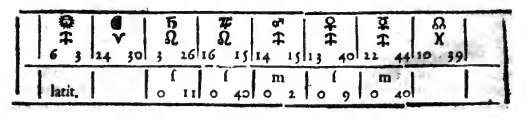

with our result :

We find at D18:

- {♀♂} ◻ ☉R
- ♃ ◻ ♄R (see D0)
- ☉ ◻ ♃R

The result to take in account is : ♂ ◻ ☉R.

These results recall those we have highlighted for the previous theme.


jeudi 15 août 2024

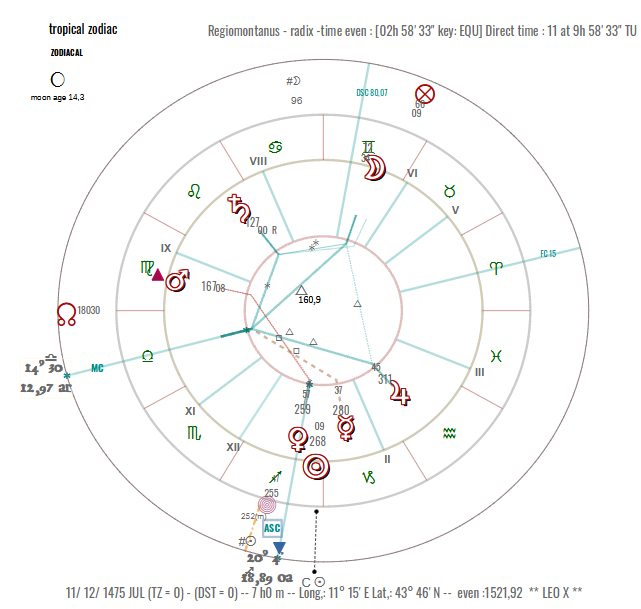
LEO X

LEO X


(Jean de Medici), pope, born in Florence in 1475, died in 1521. He was the son of Lorenzo de Medici, called the Magnificent. He is one of the most famous popes, and the name of the century of Leo X has been given to the brilliant period in which he lived. Named cardinal at the age of thirteen, he was forced to leave Florence, following the invasion of Charles VIII in Italy (1488), and came to settle in Rome, where he attached himself to Julius II, who gave him the command of Perugia. He lost the battle of Ravenna (1512) against the French, was taken prisoner, and did not recover his freedom until a year later. He was elected pope in 1513, and his reign is remarkable among all for the political or religious events which took place and for the progress of the arts. He made peace with Louis XII, later declared himself against Francis I, but negotiated with him after the battle of Marignano (1515). It is true that in 1521 he again showed himself to be his enemy by allying himself with Charles V. He had barely finished re establishing his family in Florence when the great heresy of Luther broke out. We know that the sale of indulgences was the occasion (1517); neither the anathemas of the Holy See nor his excommunications could stop its progress, and Leo X died, having been able to sense that what he had at first considered a dispute between monks was a powerful religious revolution. This pope has been criticised for his ostentation, his passion for the table, and even his habits of debauchery. Posterity, however, takes into account his taste for literature, science and the arts, and the protection he granted to the scholars and artists who illustrated his century and his reign. It is enough to mention Raphael, Michelangelo, Correggio, Ariosto, etc., the magnificent works which were carried out at Saint Peter's and the Vatican, and the foundation of the Laurentian library. [[Grand dictionnaire universel du XIXe, Pierre Larousse, tome 10, p. 370, 1873]


Gauricus, Leo X genitura


theme sources:
- Lucae Gaurici... Tractatus astrologicus, Venitiis, 1552, f. 18r
- Junctinus, Speculum Astrologiae, 1583, Lugduni, p.120 a
- Alan Leo, 1001 Notable Nativitas, n°474, art Pope, p. 35, 1917
- astrodatabank: https://www.astro.com/astro-databank/Pope_Leo_X

comments
- Alan Leo gives ASC 20°♐
- Gaurici quotes 11 December, 14 h 37 Horol. and 10 December 19 h PM

14h 37 Horol in italic hour is equivalent to 6h 58 (with sunset at 4h36) with the French system. When it is 14h 37 in the italic system (Florence), it is 7h00 at morning, the 11th of December.

So the date to retain is December 11, 1475 at 7:0 a.m. LMT (Julian calendar)


The radix aspects (between planets) are computed in mundo and aspects to the axes are computed in AR (MC, cardo rectus) or OA (ASC, cardo obliquus). So, that we find :

EQU OA-P/ASC Δ OAP OA ASC RA-P/MC Δ AR P RA MC
SU 9,25
74,65
MO 128,81
123,68 123,68
ME 25,28
88,41 88,41
VE 0,21 0,21 65,74
MA 121,39 121,39 24,13
JU 49,13
120,89 120,89
SA 173,25
63,75 63,75


On the left, the columns between planets and ASC (radix distancia oblica) or the MC (radix distancia recta). On the right, the results at ± 2° of orb. [cf. THE ASTROLOGICAL DOCTRINE OF PROJECTING THE RAYS, E.S. Kennedy and Haiganoush Krikorian-Preisler, Al-Abath, XXV, 3-15, 1972]

aspect points


MUNDANE SU MO ME VE MA JU SA
SU


MO


ME


VE


MA -4,5 Occ ∆


JU
-1,56 Occ ∆


-3,12 Or ☍

SA
-3,68 Or*


The radix aspects are evaluated by a method borrowed from Georges Muchery [l'Astrologie judiciaire - le thème natal, Editions du Chariot, 1971, pp. 19-20] and leads to results which can be negative even for aspects considered "favorable" and this because the radix points are "failing".
We see that all planets, except SA, are peregrine. Sa is Detrimental. MO, VE and SA, have specially a bad celestial value because of their house position.


SU MO ME VE MA JU SA
strength planet -5 -9 -3 -8 -9 -1 -14
house 1 6 1 12 9 2 8
score planet/house 5 -5 5 -5 2 3 -2
score house


Σ 0 -14 2 -13 -7 2 -16

After scoring we see that VE (XII), MO (VI) and SA (VIII) are bad, if we refer at least to the somatic aspect that this side of their symbolism can take on here.

Note that the radix 'conventional' ray ASC square MA is not found and replaced by ASC TRI MA (OA) in the OA system of casting rays.

THEME


SU is P with a [-2] score - house rgo 1
MO is P with a [-18] score - house rgo 6
ME is P with a [-7] score - house rgo 1
VE is P  with a [-18] score - house rgo 12
JU is P with a [-8] score - house rgo 9
MA is P with a [-15] score - house rgo 2
SA is D with a [-25] score - house rgo 8
points to specially watch for the duration of life: MO  in house VI ; VE  in house XII
no point
we see below the list of  aspects :
---------------------------------------
      SU[-4,5 Occ 120]MA       MO[-1,56 Occ 120]JU  MO[-3,68 Or 60]SA            JU[-3,12 Or  180]SA
---------------------------------------
The best aspect is  [best :su 120° (0,9) ma]  and the worst aspect is  [worst :ju 180° (-0,24) sa]


The traditional almuten (Omar, Ibn Ezra) is VE
we see below the list of dignities for VE :
---------------------------------------
[ term 2 tri 3 rul 0 exn 0 fac 2 ]
[ su 0 mo 1 asc 0 syg 2 pof 1 ]
---------------------------------------
Note 1 : the ‘almuten figuris’ is the lord of the chart, but its determination obeys somewhat different rules according to the schools. The tradition is based above all on the zodiacal dignities. (see p,e,  Alcabitius, Introduction, 59-61, 117 and Avenezra, Nativites, 101) – almuten = al-mu’tazz (arabic term)
[7] As for the governor which is the <planet> predominating (al-mubtazz) over the birth from which one indicates the conditions of the native after the haylāğ and the kadhudāh,n it is the planet having the most leadership in the ascendant, the position<s> of the two luminaries, the position of the Lot of Fortune and the position of the degree of the conjunction or opposition which precedes the birth. When a planet has mastery over two, three or four positions by the abundance of its shares in them, it is the governor and the predominant <planet> (al-mubtazz) and the indicator after the haylāğ and the kadhudāh. From it one indicates the conditions of the native. Some people use it instead of the kadhudāh in giving life.  [Al-Qabisi , Charles Burnett, Keji Yamamoto, Michio Yano, The Introduction to Astrology, IV, 7, p, 117, Warburg, 2004]
Note 2 : There are at least 4 systems for determining the almuten depending on whether the combinations of triplicities and terms are used: the Ptolemaic almuten (followed by Lilly) with Ptolemaic terms ; the same with Egyptian terms; the almuten of Dorotheus with Ptolemaic terms ; the same with Egyptian terms, knowing that one can embellish the whole thing with different weighting system (like Lilly or not using weights like Montanus) [cf. Temperament: Astrology's Forgotten Key, p. 79, Dorian Gieseler Greenbaum 2005]

The Lilly (Ptolemaïc) almuten is JU

In our experience, it seems that Ptolemy's almuten allows one to first appreciate the static side of the natal chart and that the Lilly-type elaboration allows one to deepen the more ‘temporary’ or ‘dynamic ‘ relationships (cf, Shlomo Sela, Ibn Ezra, on Nativities and Continuous Horoscopy, appendix 6, quot 2  ; Horary astrology p, 458, Brill, 2014)
---------------------------------------
Ω  166,45 / conj unfortune with caput draconis  but fortunate with cauda draconis  if alchocoden is SA or MA

Primary directions

1) papacy election 9 MARCH 1513
 

direction : [C] ☌☉ ∆☽  (directio conversa)


We notice that the direction is close to the JU-TRI MO group: it is one of the most powerful directions of the theme.

speculum Lat Dec AR MD SA HA
SU - -23,49 S 267,96 105,36 N 114,6 N 9,24 W
∆MO 3,37 N -22,78 S 311,98 61,33 N 113,72 N 52,39 W

– MD = meridian distance (from MC if SA f [SU]  is diurnal or IC if Sa f  is nocturnal)
– SA = semi-arc (if f is diurnal, SA f [SU] is D and all MD’s and SA’s are D, otherwise N
– HA = horizontal distance (from the nearest horizon W or E for f [SU] and m ∆MO)
under bracket [] the fixed point, (here SU)
- Lat ∆MO 3,37 N and lat MO : -4° 41' 25" - Aequatio is -0.17°

DP REGIOMONTANUS (5)

DP REGIO-CAMPA C
DP REGIO-CAMPA D
DIRECTIO CONVERSA A2 ∆MO A1 SU A1 SU A2 ∆MO A2 ∆MO A1 SU
Tan A tan dec/cos dm
-121,37
-35,69
B (1) +LG-A or -LG+A
77,60
8,08
Tan C cot DM.cos B/cos A
-173,53
-32,23
Sin pole (2) Cos C.sin LG
-43,42
35,82
Sin DA (3) Tan pole A1.Tan Dec A2
Tan pole A2. Tan Dec A1
DAP (*) 24,29 18,19 -13,77 -18,28
AO (4) AR ± DA
292,24 328,86 324,44 286,23
arc AO1 – AO2

-36,62
38,21


CONVERS
DIRECT

(1) B must be treated as positive number
(2) sign of pole has the same sens of LG for DA Here, DA = DA/pole A
(3) sign [-] if pole and Dec have the opposite sign – sign [+] if planet located in western half, sign [-] if planet located in eastern half ; Signs [+] and [-] must be reversed for births in the southern hemisphere
(4) to find AO of a star A2 under the pole of A1, we calculate the  DA of A2 under the pole A1 ex: tan pôleA1.tan DecA2=sin DA A2/poleA1
(5) algorithm from Gouchon (‘Dictionnaire astrologique’, Dervy, 1946, 1975, p, 276, attributed to H. Selva) ; Martin Gansten (‘Primary directions’, pp, 155-157, 2009, Wessex Astrologer) - instructions for use only appear in Gansten – Astrologia gallica, Morin de Villefranche, trad Holden (appendix 5, pp, 151-153)  - (*) ascensional difference under own pole

ARC CONVERSE
Y 36,62 Δ = 0,09
BRAHE : 1° 1' 10"
key convert 0,981


DP PLACIDUS Plac direct Plac conv
sa1/dm1 1,73 1,09
sa2 114,60 108,42
x 66,22 99,68
dm² 105,36 62,65
sign -1 -1


arc 39,14 -37,03

FOMALHAUT-CHOISNARD
X = sa2.dm1/sa1 = and the angle x = SAm x DM f/SA f, so : SA m [ 114,6°] x DM f [ 62,65°]/SA f [ 108,42°]
sign : if the two points are on either side of the meridian, take +1 ; otherwise -1
Arc = dm2 ± sign.x We find the direction by DMm - x, so : DM m [ 62,65°] ± x [66,22]

precision direct convers

Regio 1,68 -0,09

Plac 2,61 0,50

2) death : 1st DECEMBER 1521

- ♀ ☍♄
- ♄☌ ◻☽
- ∦♂ ☌☽