Affichage des articles dont le libellé est antiscia. Afficher tous les articles

vendredi 25 décembre 2020

HENRI II (3)

 HENRI II (3)

Gradually, it seems to us that the best way to represent the natal chart is the mundane form. Without going over the uncertainty of the birth time of the nativity below (Henry II), it is instructive to examine the zodiacal parallels, especially those of MO, VE, and SU, in link with their conjunction with SA. For that, we take the Max DUVAL work and add a zodiacal representation that which allows to get an idea of an intuitive representation of the diurnal movement which is at the base of the primary directions: one realizes thus that certain primary directions (pronounced in particular by modern astrologers, are clearly meaningless).

 NATAL CHART OF HENRI II (for 5:30)


 MUNDANE LOCAL CHART FOR 1559

We see the direction (z) #MO conj SA ; notice that #MO is with no latitude : so it is a contra-antiscia.

ALCHOCODEN

HYLEG = SU (Ex in ARI)

ALCHO = VE [but with the dynamic house, it is therefore in XII]

So, we have the table :


ALMUTEN


lundi 4 juin 2018

Felipe Maria infante

Felipe Maria infante


Infante of Spain, as the seventh son of King Carlos IV and Maria Luisa of Parma.
Felipe María died at the Royal Palace of Madrid on 1 March 1794, aged 1 year and 11 months.


In this chart, we have a dramatic case study: that of an antiscia aspect between SU and MA in VIII. The case is greatly complicated by the fact that MA is the alchocoden as can be seen in the following diagram:


As we see, ASC is the HYLEG and ALCHOCODEN is MA (as there is a ptolemaïc ray between ASC and MA). The examination of the dignitaries of MA shows a strong dominance of ME; Now it happens that ME is combust and is involved in addition in the antiscia aspect.


Finally, we note that MA and ME are peregrine. Moreover, MA is R. The ALMUTEN score is below :


ALMUTEN is VE.

As for the primary directions, they are, so to speak, ingrained in the theme; we find as 'radix directions' :

-  □ MO conj SA-ME
- antiscia MA conj SU-ME
- counter-antiscia SU-ME conj MA


jeudi 21 septembre 2017

COCLITIS CHIROMANTIC

HIERONYMI CARDANI - DE EXEMPLIS CENTUM GENITURARUM


XVIII


  COCLITIS CHIROMANTIS (1467-1504)

1)- introduction

OF ROCCA, Bartholomew, called Cocles. - He was born, as he states, in Bologna on 19 March 1467.
The poor biographical news on D. are mainly contained in his main work, Chyromantie ac physionomie Anastasis, in which he provides some details about his short existence. In D. Proemio's work D. remembers the place and date of birth and later (book III, chapter 251) says he was an illegitimate son (some claim that his mother was a famous midwife of Bologna) who lived always poor (ibid., chapter 183), and as a boy did the barber (ibid., chapter 208). D. was known among his contemporaries, above all with the Latin nickname Cocles, which could mean "without an eye" (but this lack is not documented), both 'grim and crude of character and appearance': this second meaning of the term seems the right one, even on the basis of the testimonies of a few authors behind the Cocles, like Cardano. The name Cocles also printed all his works.
Since he was young, D. has shown a great deal for occult sciences, and at first his focus was on magical practices and the reading of books of necromancy and alchemy. However, soon after the lack of scientific foundation of these disciplines, D. turned to the study of medicine and surgery at the University of Bologna, where he graduated in 1489.
However, D.'s fame is not related to his profession of physician, but to the studies of chiromanzia and physiognomy to which he devoted himself with growing passion, especially after his encounter with the Aristotelian philosopher Alessandro Achillini, who had founded at the Studio bolognese a philosophical-naturalist school. The D. became part of the circle of the disciples of the Achilles, to whom he was deeply adored and with whom he shared the interest in occult sciences. Following the study and practice of these subjects, D. began to perform many vices and predictions with the aim of showing that through the scientific study of human characters it was possible to identify the fate of each one on a concrete basis, astrology operating instead on an abstract field.
Some predictions made by D. and timely occur, made him a big fame among his contemporaries. They began addressing him illustrious figures such as Galeazzo Sforza, brother of the Duke of Pesaro, and soon D. was invited to visit many cities of Romagna, called by their respective rulers, to preach their future. In a letter from Orazio Bicardi di Fano written to Alessandro Bentivoglio on 15 December. 1503 - which is another valuable source for rebuilding D.'s life - is said to have left his country house near Bologna, he first went to Imola, where he predicted the master of that city the end of his rule, then in Faenza, where he had a sad event for Astorgio di Faenza, who died shortly afterwards. From there he went to Rimini, Cesena and Pesaro and met also with the Duke of Urbino Guidubaldo. Also to Giulio Varano, Lord of Camerino, and his sons, he predicted a fateful destiny. But the fame of a prophet of misfortune prompted D. to drive him out of all the courts visited, forcing him soon to return home. In Bologna, for D. he began a period of tranquility, in which he could devote himself to the writing of his text on the physiognomy and coincidence, which began in about 1500 and which saw him engaged until June 28, 1504. On 4th of August, 1504 the work was printed at GA Benedetti in Bologna with the title of Chyromantie ac physionomie Anastasis, cum approbatione magistri A. Achillini. During this period D. also had the task of the Studio di Bologna to teach grammar, academic year 1503-04, to four "poor shameful" cities, without any remuneration, according to custom.
Twenty days after the publication of his work, on the 24th of September, 1504, D. died, in Bologna, assassinated almost certainly by the hand of an Antonio Caponi.


2) natal chart


- FOMALHAUT dom 106°07' Campanus ; ALGOL dom 188°09'
  • ASC SCORPIO, ruler MA (II, CAPRI)
  • MC VIRGO, ruler ME (IV, PISCES) - FOMALHAUT opp MC
  • MO conj ALGOL, opp ASC, conj JU
- HYLEG : ASC
- ALCOCODEN : MA
- ANAERETE : SA

Morinus gives MA for ALMUTEN. We have in domitude : MA // SA.
3 planets are detrimental : ME (+) EXIL and opp MC (IV, cadent) - VE - SA

It is also very interesting to see the antiscion.


Due to the accidental disposition of the planets, one notices a rather surprising configuration : ME, VE and SU, SA are covered by their antiscion mirroring images :

PARALLELES. There are two kinds of parallels : zodiacal and mundane. Zodiacal parallels are circles équidistant from the equator, namely, the beginning of ARIES and LIBRA, and consequently any two points of the zodiac haying equal déclination, whether of the same or the opposite kind are in zodiacal parallel with each other. Thus, a star in 2° of another in 28° degrees of CAPRI, anotber. in 2° of GEMINI and another in 28° of CANCER, would all be in zodiacal parallel to each other, because they would all have the same declination in the number of degrees and minutes, viz. 20° 38'. The two first are called antiscions, because they have the same declination in number and name, viz. 20° 38' south declination ; the others are also antiscions in the same way, as having 20° 38' north declination, but the two former are called contra antiscions to the two latter, because, although their declination is the same in number, it is different in name, one being north and the other south declination. Those having north declination are called commanding, and the Southern, obeying : because the north being nearer our zenith must be most powerful. An antiscion is held by some to have the effect ot a * or v and a contra antiscion that of a □ or o-o, but Placidus makes no such distinction. [A Complete Dictionary of Astrology, in which every technical ... term ... Par James WILSON, London, 1819]

Note particularly the superposition  of ME and VE.

3)- primary directions

a)- SU opp MC


D = ts-ARsu = -177.79 (or 2.20° IC - recall : the birth hour is approximate for the axis directions). It should be known that this type of direction: SU opp MC (conj IC) is often encountered during the brutal deaths.

b)- SA conj ME


results :


overall results - primary and mundane Rp

%
1 C Regio Campa 1 0,1
0 D Placidus 1 0
0 D Regio Campa
0 overall diff,
1 C Placidus
0,1 0,1
2


0

1503,75

0
fictitious C SU opp. MC Dir % 0,1
0 D – AR 0 0 0
0 AO 0 0
0 Gold Regio 0 0
0 Gold Placid 0 0
0 Symb 0 0
0


We find 2 primary directions and none fictitious ; so the overall difference is 0.1 x2.

c)- #MO conj MA (in zodiaco)


- result


overall results - primary and mundane Rp

%
1 C Regio Campa 2 0,3
1 D Placidus 2 0,2
1 D Regio Campa
0,2 overall diff,
1 C Placidus
0,3 -0,3
4


0,2

no ray

0,2
fictitious C MA # MO Dir % 0,3
0 D – AR 0 0,6 -0,2
0 AO 0 0
0 Gold Regio 0 0
0 Gold Placid 0 0
2 Symb 2 0,2
2


We have 2 Placidus and Regio directions ; 2 symbolic directions as fictitious.


lundi 3 juillet 2017

Worsdale (1)

Joseph Kent


The following Nativity is that of Joseph Kent; this Child lived, with his Parents in the City of Lincoln, and on the twelfth of July, 1824, in consequence of his not returning home from school at the usual time in the Evening, his Relatives were alarmed for his safety, and applied to me, on the morning of the following day, Requesting my Judgment, whether he was living or dead; they informed me that he was bom at Liverpool, on the 6th of June, 1817, at half past eleven at night, and further observed I might depend that the time of his Birth, was exact, being taken by his Father, (who is now living,) with the greatest care and attention; As soon as 1 had observed that the Effects of the mortal Directions to the true Hyleg were then in operation, and that all the secondary significators of Life were likewise afflictedr both by position, and Direction, without any relief from, benefic irradiations, the giver of life being angular, in Pisces, a sign of the watery Trigon, with Saturn, & applying to the Body of that Malefic by a converse Motion, and also to the Zodiacal Parallel, and conjunction of Mars, by a direct Direction; I then delivered my Judgment, that the Child was drowned, and told those who applied to me on this melancholy occasion, that the River, which had been superficially examined, ought to be more diligently explored, which was accordingly done, and the Body was found near the Swivel Bridge, though all signs of Life had disappeared; these facts are well known to the Inhabitants of Lincoln. I have inserted this Nativity with the following directions, & judgment, which will doubtless be considered as an interesting Example, by all those; who are seriously inclined to investigate, and prove the true principles of this Heavenly Science. [John Worsdale, Celestial philosophy, pp. 83-9, Longmann, 1828]

Cette carte apparaît p. 84 de Celestial philosophy. Elle est suivie, comme à l'accoutumée chez Worsdale, d'une liste de directions qui semble exhaustive. Comme je l'ai dis ailleurs, ce thème a fait l'objet d'un post dans le forum : http://skyscript.co.uk/forums/viewtopic.php?t=7182 où l'on remarque plusieurs exemples de programmes en action (Janus, Placidus, Morinus...). C'est dans c epost, notamment, qu'une allusion est faite sur les parallèles de déclinaison qui ont semblé si importants à Placidus.


Vous voyez ici le thème « moderne » de cette géniture. Il y a deux lieux « hylégiaux » en maison I (présence de la Lune) et en maison IV (présence su Soleil) ; malheureusement, Mars et Saturne encadrent la Lune directement, situation à toujours examiner avec soin. La maison I s'étend largement eu égard à la latitude et sa maîtrise se partage entre Sa et Ju. Le So est placé à l'IC, position difficile en IV. La coïncidence fait que dans ce thème, plusieurs planètes sont en domicile : Mars (Aries), Vénus (Taurus), Mercure (Geminis) et Jupiter (Sagittarius) ; c'est plus que la moyenne. Notons également que le maître du MC est donc Ju, lui-même pratiquement au méridien, en IX.

L'examen des domitudes Campanus montre une conjonction entre Lu (15° en I) et Ma (18° en I) que ne laisse pas forcément deviner le thème zodiacal (les latitudes planétaires sont assez conséquentes : surtout pour Lu à - 4°53'38"). Les domitudes Placidus sont moins rapprochées et l'on note un # Jupiter - Soleil.

Les étoiles sont fâcheusement placées, avec Algol en conjonction apparente avec Vénus ; Alpheratz avec Mars. Algol a une domitude Plac. non calculable eu égard à sa latitude, combinée à la latitude géographique ; toutefois, en domitude Campanus, on constate que Mars est en conjonction avec Algol... Quant à Alpheratz, sa domitude est de 344°19'.


Le thème d'antisce est des plus instructifs : les // de Mars et de la Lune sont en quelque sorte conjugués ; par ailleurs, Vénus est en // avec ASC (Vénus étant en conjonction apparente avec Algol).
Une question à présent concernant la valorisation potentielle concernant le devenir somatique de l'individu. L'almuten est Jupiter ; toutefois, il ne s'agit pas de l'hyleg ; l'hyleg est constitué par la Lune, située en maison I ; son maître est Jupiter : il s'agit donc de l'alchocoden.
Next comes genethlialogy or nativities (nativitates : genezui), by which birth charts are drawn up and the course of life of the newborn child—or native (natus)— is predicted. One must determine the “hvleg” or “prorogator” (dator vite : hi leg, hylech, yleg (Arabic haylaj], dominus/significator vite), which is a point on the ecliptic worked out by complicated means, anti the planet with the most dignities in this point, which is called the lord of the house {dominus geniture : alc[h]ochoden, al-tothoden—Arabic al-kadhkhudah). The combined evidence of these two gives the length beyond which the life of the native cannot naturally extend, as well as indicating diseases and hardships in the course of the life. 1'he events in different areas of the native's life can be discovered from looking at the situation of the planets in regard to the 12 places. Moreover, each planet as chronocrator rules over a certain number of years of the native’s life; these are called the planet's “firdaria” (*: afraadet (pi.), alfardaria, alfirdariech, alfridaria, firdaria [Arabic fardar]). It was a common practice to cast a horoscope when the sun returned to the same degree of the zodiac where it was at the time of birth, and to compare it to the astrological chart of the birth (radix). This subbranch of genethlialogy is called solar returns or anniversary horoscopes (revolutiones nativitatum). [Medieval Latin: An Introduction and Bibliographical Guide, Frank Anthony Carl Mantello,A. G. Rigg, p. 375, The Catholic University of America Press, 1996]
Nous allons relever à présent les directions qui encadrent l'âge du décès.

1)- Mars conjonction Lune C


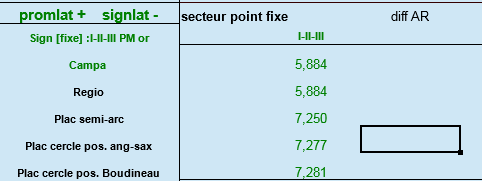
Cet extrait de feuille de calcul montre une vue globale des principaux systèmes de directions primaires ; on relève notamment les arcs Placidus (cercle de position anglo-saxon à 6.97 et cercle de pos. Boudineau à 7.01) en clef de Ptolémée.

2)- Soleil opposition MC


C'est la direction la plus simple : elle s'écrit ARm - TS où Arm est l'AR du Soleil (74,582°) et le TS = 247,515°. On trouve 7.07 (Ptolémée).


3)- # Lune conj Mars


Ici, nous dirigeons un point-aspect (# Lune) à un point fixe (Mars) ;  profitons-en pour discuter un point de technique somme toute important ; il s'agit d'une direction D (directe) ; évidemment cela peut étonner que l'on dirige à la façon d'un point fixe un point aspect. Je ferai remarquer que le # Lune n'est pas un aspect stricto sensu mais un parallèle (en l'occurrence un contre-parallèle). L'important n'est pas là mais bien dans la question de savoir s'il ne convient pas, dans ce cas de figure, de calculer la direction C (converse) : i.e. faire « avancer » le point mobile que devient le significateur (Mars) pour qu'il parvienne en position semblable avec le point-aspect (à qui échoit une situation fixe).

a)- #Lune prometteur (direction directe)


On remarque que les arcs coïncident davantage avec la méthode Placidus.

b)- #Lune significateur (direction converse)


Les arcs sont ici presque équivalents. Ils seraient différents relativement à un âge plus élevé.

4)- conclusion


Worsdale [Celestial philosophy, p. 85] a parfaitement analysé l'ensemble des directions et en particulier, le // de Lune à Mars in zodiaco et la conjonction de la Lune à Mars in mundo. Je retiens l'opposition du MC au Soleil in mundo.

This Child wad drowned at the Age of seven years, one Month, and six days, and the Directions that destroyed Life, (which shewed their effects at the time of Death,) were the Moon Hyleg, to the Body of Saturn, by Converse Motion, and also the parallel Declination of Mars, and body of that Malefic in the Zodiac, and Mundo; those Directions [Worsdale, CP, 88]
Quant à la direction de Lune à Saturne, on la trouve de la façon suivante :

- à la domitude Placidus de la Lune (23.148°), on retranche l'arc de 11.291° trouvé en direction convers :
où dm est la distance méridienne nocturne du point mobile (Saturne en convers) ; SAnf, le semi-arc nocturne du point fixe (la Lune) et Sanm, le semi-arc nocturne du point mobile (Saturne). Les paramètres sont listés dans le tableau suivant

G / A promissor significator
long 348,684 335,936
lat -4,894 -1,571
AR 351,537 338,313
dec -8,981 -10,804
ha -1,816 -1,585
OA 363,823 353,202
dom Campa 15,625 9,175
dom Regio 25,130 15,158
Dom Placidus 23,148 13,460
pôle Regio 50,638 52,424
pôle Campa 50,638 52,424
Pôle Placidus
48,959
DM D|N D |104,022 -
N |75,978
D |90,798 - N |89.202
DA pôle D|N
D |17,999 - N |-12,662
DA -12,286 -14,889
SA D|N D |77,71 N |102,29 D |75,11 N |104,89
D Horiz -26,31 -15,69
Htd* 17,048 17,481
DH** 6,102 5,194

*  heure temporelle (= 1/6e SAd)
** distance horaire, superposable aux positions mondiales

soit : 75.97*(1-104.89/102.29) =1.931
D = (351.537 - 338.313)-1.931 = 11.293.