HIERONYMI CARDANI - DE EXEMPLIS CENTUM GENITURARUM
XIII
ALCIATI ANDREAE (1492-1550)
1)- introduction
Commonly known as Alciati (Andreas Alciatus), was an Italian jurist and writer. He is regarded as the founder of the French school of legal humanists. Alciati was born in Alzate Brianza, near Milan, and settled in France in the early 16th century. He displayed great literary skill in his exposition of the laws, and was one of the first to interpret the civil law by the history, languages and literature of antiquity, and to substitute original research for the servile interpretations of the glossators.[3] He published many legal works, and some annotations on Tacitus and accumulated a sylloge of Roman inscriptions from Milan and its territories, as part of his preparation for his history of Milan, written in 1504-05.[4]
Alciati is most famous for his Emblemata, published in dozens of editions from 1531 onward. This collection of short Latin verse texts and accompanying woodcuts created an entire European genre, the emblem book, which attained enormous popularity in continental Europe and Great Britain.
Alciati died at Pavia in 1550. [
wikipedia]
Cardano, writing in 1543, used the horoscope of Andrea Alciato to explain his miraculous eloquence. Gaurico, writing almost ten years later, used the same horoscope to show that the malevolent influence of Saturn, credited by Cardano with making Alciato a great man, had killed him in 1546, in his early fifties [
Cardano's cosmos, Anthony Grafton, Astrologers in collision, p. 101]
Another important connection was with Andrea Alciato. Cardano published Alciato’s geniture in 1543 but dated his personal friendship with him from the time when both of them were teaching at Pavia—that is, the brief period between 1546 and 1550 (the year of Alciato’s death). Cardano later remembered their relation as one of mutual admiration, recording with pride Alciato’s appreciation of his work, especially De consolatione. Before returning to Italy, Alciato had spent many years in France and had acquired widespread fame and numerous contacts in northern Europe. It is conceivable that his example may have played a part in encouraging Cardano to look beyond Italy for his readers. Cardano accompanied Alciato’s geniture with a narrative in which he praised his Latinity and prolific authorship and judged the content of his epistles and orations superior to those of Erasmus. Yet their views were not in complete harmony, as Alciato was a strong critic of occult sciences in general and of astrology in particular. Consequently, Cardano expressed his objection to the critique of astrology in two of Alciato’s emblems (a critique echoed in antiastrological remarks in the histories of both Vegio and Merula). [History, Medicine, and the Traditions of Renaissance Learning Par Nancy G. Siraisi, p. 152, the University of Michigan Press, 2008]
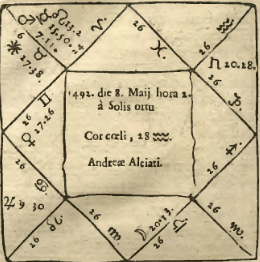
[Gauricus, 73 ; Junctinus 542b - Cardano 466 XIII, Centum geniturarum - Garcaeus, 146]
I opted for the lesson of Junctinus (1h30 PM ab ortu solu)
- ASC GEMINI, ruler ME (TAURUS, XII)
- VE (I) - JU (I)
- MC AQUARIUS, ruler SA (AQUARIUS, IX)
- conj. MA-ME
- HYLEG : VE
- ALCOCODEN : MO (LIBRA, V)
- ANAERETA : SA
Morinus gives VE for ALMUTEN and SU is weak. We find that MA is detrimental.
2) primary directions
- 1518 : He took up his first academic post as professor of civil law in the papal city of Avignon. In 1518 he was named by Claude Chansonnette as part of a great legal triumvirate along with Zasius and Bude.
We find a mundane primary direction : C VE conj SU (Morinus, 1517).
We count 2 Regio-Campa (0.9) and 2 Placidus (0.4) directions ; 2 Goldmayer Regio (0.7) and Placidus (0.2) [recall : weights in brackets].
- 1529-1533. The years at Bourges mark the height of Alciato's professional career. His large stipend was increased by honoraria from King Francis, large crowds attended his lectures, among them many dignitaries, and despite his teaching he was able to produce a stream of substantial legal treatises. On
February 8, 1531, Henry Steyner published in Augsburg the first printed edition of his emblems: Viri Clarissimi D. Alciati lurisconsultiss. Mediol. ad C. Chonradum Peutingerum Augustanum, lurisconsultum Emblematum liber (No. 2 in Green; reprint, Hildesheim: Georg Olms Verlag, 1977). There was a second edition April 6, 1531 (No. 3 in Green). An edition of July 29, 1534, marks the end of the Augsburg series. Each of these contained 104 emblems.
We have the mundane ray C JU conj SU (1533).
We find in the table the weighted results associated to these rays.
| overall results - primary and mundane Rp |
|
|
% |
| 2 |
C Regio Campa |
4 |
0,2 |
| 2 |
D Placidus |
3 |
0,4 |
| 2 |
D Regio Campa |
|
0,2 |
| 1 |
C Placidus |
|
0,1 |
| 7 |
|
|
|
|
1531,35 |
|
|
| fictitious |
C JU conj. SU |
Dir |
% |
| 0 |
D – AR |
0 |
0 |
| 0 |
AO |
0 |
0 |
| 1 |
Gold Regio |
1 |
0,2 |
| 0 |
Gold Placid |
0 |
0 |
| 0 |
Symb |
0 |
0 |
| 1 |
|
|
|
|
Rp |
|
|
| fictitious |
|
Dir |
|
|
|
|
|
| 0 |
AR <--→ Campa |
0 |
|
| 0 |
AO <----→ Regio |
0 |
|
| 0 |
Symb <----→ Placid |
0 |
|
- 1534 : 1533-1537. Alciato began to teach at Pavia November 1527. These were not happy years: he was earning less money, had fewer students, and he was held in less honour than he had been in France. In 1534 Christian Wechel issued at Paris a new edition of the emblems, mentioning that the Germans, meaning Steyner, had done their work carelessly in their editions. The little volume was entitled simply Andreae Alciati Emblematum Libellus. In February, 1535 Alciato sent a copy of this new edition as a gift to Pietro Bembo. In an accompanying letter Alciato noted that he had been forced to disown the Augsburg editions because they had been published corruptissime
- SA // ME
We find here 0.6 C Placidus directions. [weighted bounds : 0 (0/10) - 1 (10/10)].
By 1539, Alciati had received letters from Milan in the name of the Emperor recalling him to Pavia. Despite an urgent plea to Marchese del Vasto, the governor of Milan, that he be allowed to remain in Bologna, he was forced to return to Pavia in 1540.
1540-1542. After two years at Pavia, because of the tumult of war, Alciato was permitted to accept the invitation of Duke Ercole d'Este to teach at Ferrara.
- C JU conj MA
We have :
| overall results - primary and mundane Rp |
|
|
% |
| 1 |
C Regio Campa |
2 |
0,6 |
| 2 |
D Placidus |
4 |
0,2 |
| 1 |
D Regio Campa |
|
0,5 |
| 2 |
C Placidus |
|
0,2 |
| 6 |
|
|
|
|
1540,59 |
|
|
| fictitious |
C JU conj. MA |
Dir |
% |
| 0 |
D – AR |
0 |
0 |
| 0 |
AO |
0 |
0 |
| 1 |
Gold Regio |
1 |
0,5 |
| 1 |
Gold Placid |
1 |
0,2 |
| 0 |
Symb |
0 |
0 |
| 2 |
|
|
|
|
Rp |
|
|
| fictitious |
|
Dir |
|
|
|
|
|
| 0 |
AR <--→ Campa |
0 |
|
| 0 |
AO <----→ Regio |
0 |
|
| 0 |
Symb <----→ Placid |
0 |
|
- ME // SA
Here, we have the two ray directions : C JU conj MA and ME // SA.
results :
| overall results - primary and mundane Rp |
|
|
% |
|
| 2 |
C Regio Campa |
2 |
0,2 |
|
| 0 |
D Placidus |
1 |
0 |
|
| 0 |
D Regio Campa |
|
0 |
overall diff, |
| 1 |
C Placidus |
|
0,1 |
0,2 |
| 3 |
|
|
|
0 |
|
1539,35 |
|
|
0 |
| fictitious |
C ME // SA |
Dir |
% |
0,1 |
| 0 |
D – AR |
0 |
0 |
0 |
| 0 |
AO |
0 |
0 |
|
| 0 |
Gold Regio |
0 |
0 |
|
| 0 |
Gold Placid |
0 |
0 |
|
| 0 |
Symb |
0 |
0 |
|
| 0 |
|
|
|
|
|
Rp |
|
|
|
| fictitious |
|
Dir |
|
|
|
|
|
|
|
| 0 |
AR <--→ Campa |
0 |
|
|
| 0 |
AO <----→ Regio |
0 |
|
|
| 0 |
Symb <----→ Placid |
0 |
|
|
1542-1546. The years in Ferrara went well. In 1542 Wechel published a new edition of the emblems: Les Emblemes de Maistre Andre Alciati, puis nagueres augmentez par le diet Alciat, et mis in rime francoise, avec curieuse correction, containing two new emblems at the end, nos. 114 and 115.
We take the mean year 1543.
In this chart, we see the 'good' direction JU conj ME ; but we see also the 'evil' direction ME conj SA in 1546, year of death. Don't forget that ME is the ruler of ASC...
Here, we find :
| overall results - primary and mundane Rp |
|
|
% |
|
| 1 |
C Regio Campa |
2 |
0,1 |
|
| 3 |
D Placidus |
5 |
0,3 |
|
| 1 |
D Regio Campa |
|
0,3 |
overall diff, |
| 2 |
C Placidus |
|
0,3 |
0,1 |
| 7 |
|
|
|
0,3 |
|
1542,41 |
|
|
0,1 |
| fictitious |
C JU conj. ME |
Dir |
% |
-0,3 |
| 0 |
D – AR |
0 |
0 |
0 |
| 0 |
AO |
0 |
0 |
|
| 1 |
Gold Regio |
1 |
0,2 |
|
| 0 |
Gold Placid |
0 |
0,6 |
|
| 0 |
Symb |
0 |
0 |
|
| 1 |
|
|
|
|
|
Rp |
|
|
|
| fictitious |
|
Dir |
|
|
|
|
|
|
|
| 0 |
AR <--→ Campa |
0 |
|
|
| 0 |
AO <----→ Regio |
0 |
|
|
| 0 |
Symb <----→ Placid |
0 |
|
|
1546-1550. Alciato's last years and final post at Pavia were less than satisfactory. His health was beginning to deteriorate and his stipend reduced. In 1548 Sebastian Gryphius published a volume of a number of Alciato's legal writings to which he added the two hundred and one combined Alciato emblems without devices. Alciato died January 11-12, 1550. The last eleven new emblems, published in 1549, 1550 and 1551 were in the hands of the printers by the time of his death.
The last directions : ME conj SA 1545 (see precedent chart) and SA opp VE 1550.
Here, we see : 0.2 C Placidus.
- SA opp ME (1550)
In this case, we find :
With the table :
| overall results - primary and mundane Rp |
|
|
% |
|
| 1 |
C Regio Campa |
1 |
0,2 |
|
| 0 |
D Placidus |
1 |
0 |
|
| 0 |
D Regio Campa |
|
0 |
overall diff, |
| 1 |
C Placidus |
|
0,1 |
0 |
| 2 |
|
|
|
0 |
|
1549,5 |
|
|
0 |
| fictitious |
C SA opp. VE |
Dir |
% |
0,1 |
| 2 |
D – AR |
2 |
0,2 |
0 |
| 0 |
AO |
0 |
0 |
|
| 0 |
Gold Regio |
0 |
0 |
|
| 0 |
Gold Placid |
0 |
0 |
|
| 0 |
Symb |
0 |
0 |
|
| 2 |
|
|
|
|
|
Rp |
|
|
|
| fictitious |
|
Dir |
|
|
|
|
|
|
|
| 0 |
AR <--→ Campa |
0 |
|
|
| 0 |
AO <----→ Regio |
0 |
|
|
| 0 |
Symb <----→ Placid |
0 |
|
|
Finally, we have a zodicacal primary direction : C SU conj SA :
- results :
with : 0.4 C Regio-Campa.
| overall results - primary and mundane Rp |
|
|
% |
|
| 2 |
C Regio Campa |
2 |
0,4 |
|
| 0 |
D Placidus |
0 |
0 |
|
| 0 |
D Regio Campa |
|
0 |
overall diff, |
| 0 |
C Placidus |
|
0 |
0,4 |
| 2 |
|
|
|
0 |
|
1549,32 |
|
|
0 |
| fictitious |
C SU conj. SA |
Dir |
% |
0 |
| 0 |
D – AR |
0 |
0 |
0 |
| 0 |
AO |
0 |
0 |
|
| 0 |
Gold Regio |
0 |
0 |
|
| 0 |
Gold Placid |
0 |
0 |
|
| 0 |
Symb |
0 |
0 |
|
| 0 |
|
|
|
|
Conclusion
Cardano, no doubt influenced by the emblem book of his friend Andrea Alciati, said dream images work like emblems; his method of analysing the composition of dreams was analogous to methods of art criticism.
Emblemata (1621), Padua, emblema CIV, in astrologos
Henry Green,
Andrea Alciati and his Book of Emblems. A Biographical and Bibliographical Study (London: Trübner, 1872), 152.
John Landwehr,
French, Italian, Spanish and Portuguese Books of Devices and Emblems 1534-1827 (Utrecht: Haentjens Dekker and Gumbert, 1976), 99.
Andreas Alciatus,
1. The Latin Emblems, Indexes and Lists (Index Emblematicus), ed. Peter M. Daly with Virginia W. Callahan, assisted by Simon Cuttler (Toronto: University of Toronto Press, 1985).